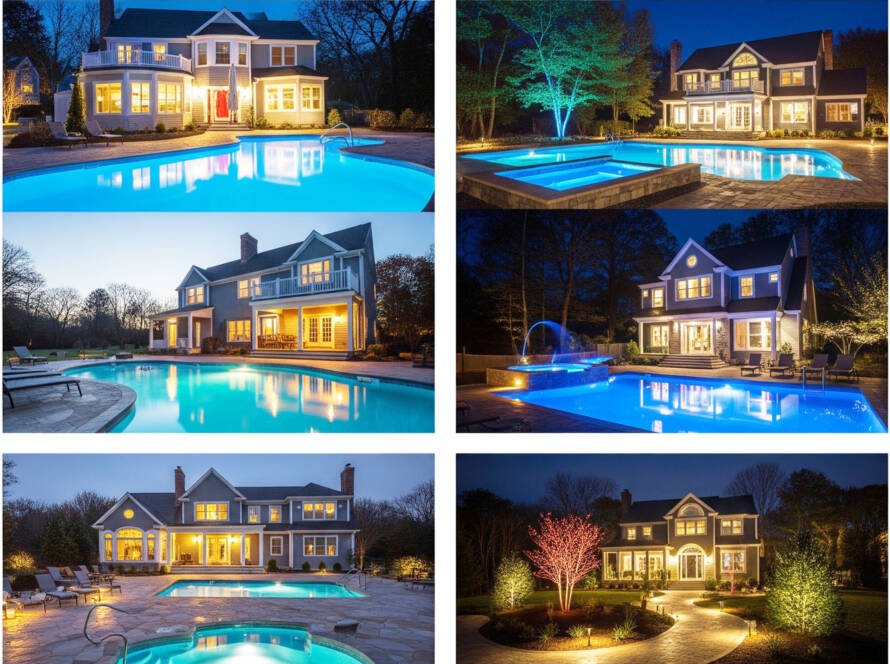
Landscape lighting is one of the highest-impact, lowest-disruption upgrades you can make to a Massachusetts home — and it’s arguably more valuable here than almost anywhere, because our winter days get dark by mid-afternoon and a well-lit yard means safety on icy paths and enjoyment of your property year-round. But pricing ranges widely depending on how many fixtures you need, their quality, and the design. This 2026 guide breaks down landscape lighting costs in Massachusetts by fixture, by system size, and including the transformer, wiring, and design that make up a real quote.
Key Takeaways
- Average cost: $3,000–$7,000 for a quality professional system in Massachusetts (2026); ~$100–$350 per installed fixture.
- Biggest cost factors: number of fixtures, fixture quality (brass vs aluminum), and design complexity — not property size.
- Go LED, always: LEDs use ~75% less energy and last 25,000–50,000 hours; the upfront premium over halogen is small, the lifetime savings large.
- The New England factor: short winter days make lighting more valuable, solar underperforms here, and coastal salt air demands solid brass fixtures.
- Low-voltage (12V) is the standard for homes — safe, reliable, and usually permit-free (line-voltage 120V needs a licensed electrician and permit).
How Much Does Landscape Lighting Cost in Massachusetts? (2026)
A professional landscape lighting system in Massachusetts costs $3,000 to $7,000 on average in 2026, though the range is wide. What drives your number isn’t your yard’s square footage — it’s the number of fixtures, their quality, and the design complexity. Here’s how costs scale with system size.
| System Size | Fixtures | Typical Installed Cost (MA, 2026) |
| Starter (curb-appeal basics) | 5 – 8 | $800 – $2,500 |
| Mid-range (front yard + focal points) | 10 – 15 | $2,500 – $6,000 |
| Whole-property | 20 – 30 | $6,000 – $12,000 |
| Luxury / custom (brass + smart controls) | 30+ | $10,000 – $20,000+ |
Most Massachusetts homeowners land around $3,000–$7,000 for a professional low-voltage LED system that lights a front walkway, a few trees, and key architectural features. You can start smaller and expand later — one of the advantages of a low-voltage system.
Because metro Boston and North Shore labor rates run above the national average, expect Massachusetts pricing toward the higher end of national ranges — especially where trenching runs through established landscaping or hardscaping.
Landscape Lighting Cost by Fixture Type
Different fixtures do different jobs, and their installed costs vary. Here are typical 2026 per-fixture prices in Massachusetts, including the fixture, wiring share, and labor.
| Fixture Type | What It Does | Installed Cost (Each) |
| Path light | Lines walkways, driveways, beds | $100 – $250 |
| Spotlight / uplight | Highlights trees and architecture | $120 – $350 |
| Well light | Flush in-ground uplighting | $150 – $350 |
| Wall wash / grazing | Washes facades and stone walls | $150 – $350 |
| Step / deck light | Lights stairs and decks for safety | $100 – $250 |
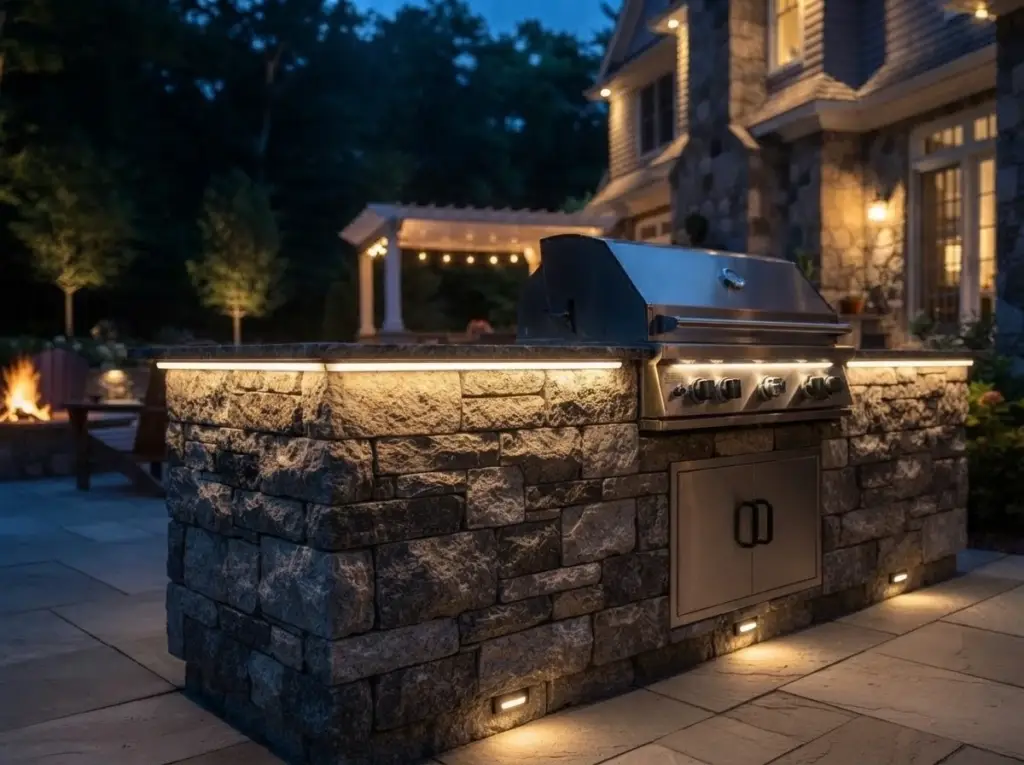
| Hardscape light | Built into retaining and seat walls | $100 – $250 |
| Downlight / “moonlighting” | Soft light cast down from trees | $150 – $350 |
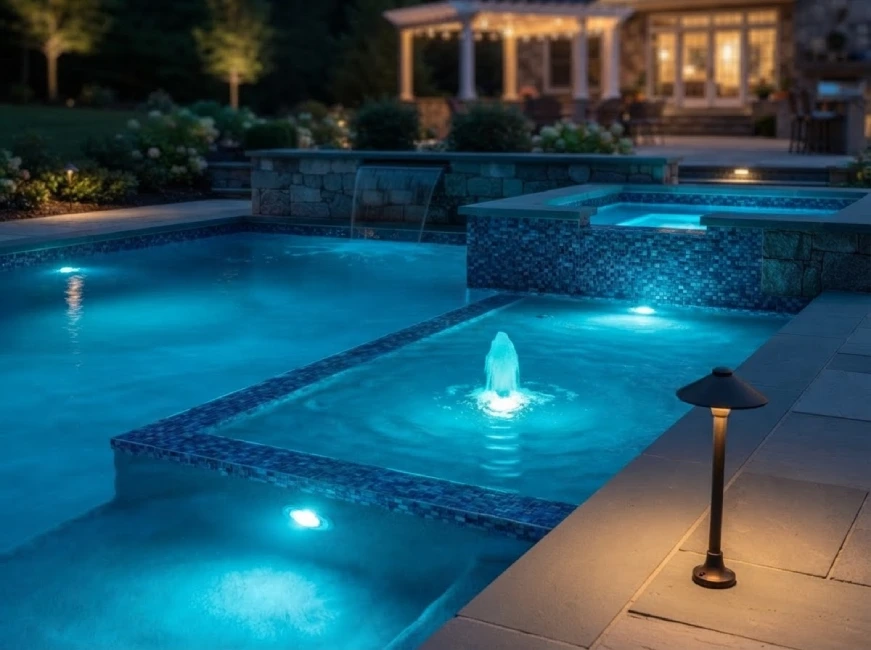
| Underwater / pool light | Pools and water features | $200 – $500 |
| String / bistro lighting | Ambiance over patios and pergolas | $300 – $1,000+ per run |
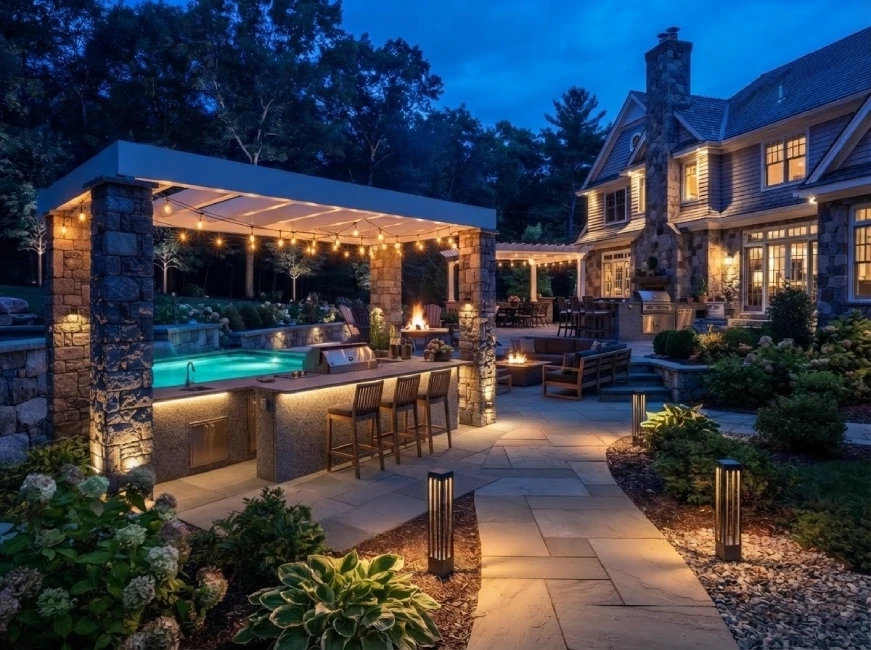
The two most commonly installed categories are uplighting for trees and pathway lights — together they deliver the biggest visual impact for the money. A cohesive plan usually layers several fixture types for depth.
What’s in a Landscape Lighting Quote?
Understanding the components helps you compare bids and spot a quote that’s cutting corners on quality (which shows up fast in our climate).
| Component | Typical Cost | Notes |
| Fixtures (LED) | $100 – $350 each installed | Solid brass lasts far longer than plated/aluminum |
| Transformer | $150 – $800 | Sized 20–50% above total fixture load |
| Wire + trenching | $3 – $5 / linear ft | Low-voltage wire buried a few inches deep |
| Labor | 40–60% of project | Higher in metro Boston / North Shore |
| Lighting design | Varies | Prevents overlighting and poor placement |
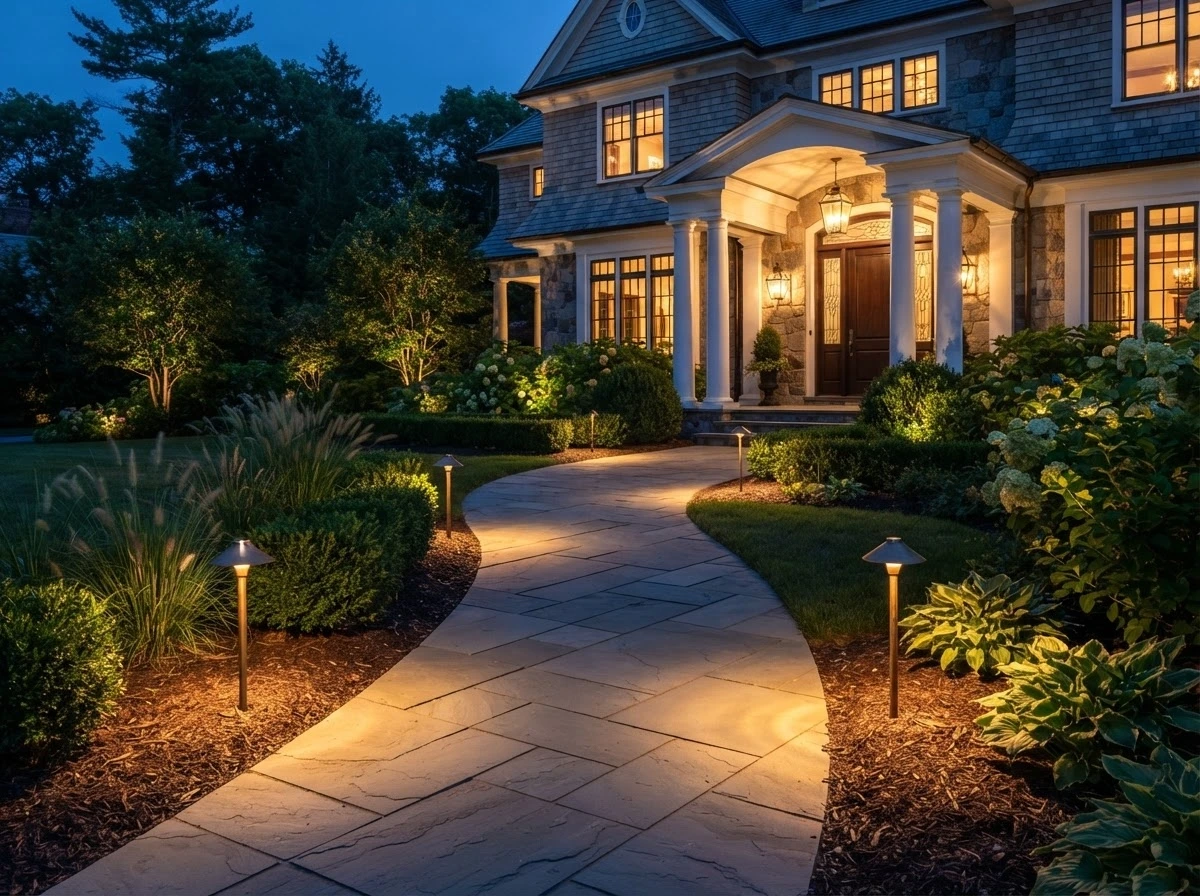
The quality that pays off: budget brass-plated fixtures ($15–$40 each) can corrode within 3–5 years, while solid brass or copper fixtures last 15–25 years. In a wet, snowy, salt-air climate, cheaping out on fixtures is the fastest way to a system that looks tired in a few seasons.
Low-Voltage vs Line-Voltage vs Solar: Which Is Best for New England?
| Type | Typical Cost | Best For | New England Note |
| Low-voltage (12V) LED | $100 – $350 / fixture | Most residential lighting | The standard — safe, reliable, usually permit-free |
| Line-voltage (120V) | Higher + electrician | Powerful or distant fixtures | Requires a licensed electrician and permit |
| Solar | $10 – $150 / fixture (DIY) | Quick, cheap accents | Underperforms in short winter days and snow cover |
Low-voltage (12V) LED is the standard for residential landscape lighting — it’s safe, energy-efficient, and easy to expand. A transformer steps your home’s 120V power down to 12V, so it doesn’t carry the shock risk or permitting requirements of line-voltage systems.
Solar is tempting but a poor fit for New England. Our short winter days, low sun angle, and snow cover mean solar fixtures charge weakly and dim early, exactly when you need light most. For a system you’ll actually rely on November through March, low-voltage LED is the smart investment.
LED vs Halogen
Modern landscape lighting is LED, and for good reason: LEDs use roughly 75% less energy than halogen, run cool, and last 25,000–50,000 hours versus a couple of thousand for halogen. The upfront cost difference is small; the lifetime difference in energy and replacement cost is substantial. When comparing quotes, always confirm the contractor is specifying LED, not legacy halogen.
Why Landscape Lighting Costs More — and Is Worth More — in Massachusetts
Landscape lighting is one of the few outdoor upgrades that arguably delivers more value in New England than in warmer regions. Here’s why our climate matters.
Short, Dark Winter Days Make Lighting a Year-Round Asset
In a Massachusetts winter, it’s dark by mid-to-late afternoon. A lit landscape means safe, visible walkways and steps when they’re icy, plus you actually get to enjoy your home’s exterior during the long dark months instead of staring at a black yard. This is the single biggest reason lighting is worth it here — it’s not just for summer evenings.
Coastal Salt Air Demands Solid Brass
On the North Shore and near the coast, salt air corrodes cheap fixtures quickly. Solid brass and copper fixtures — which develop a handsome patina and last decades — are worth the premium, while plated or aluminum fixtures can pit and fail in just a few years.
Frost, Freeze-Thaw, and Proper Burial
Low-voltage wiring must be buried and connections weatherproofed so freeze-thaw cycles and frost don’t damage the system. Proper wire gauge and burial depth also prevent voltage drop, where fixtures at the end of a long run glow dimmer than the rest — a common failure of amateur installs.
Snow, Plows, and Fixture Placement
Fixtures near driveways and walkways have to be placed with snow removal in mind, so plows and shovels don’t shear them off. And because the ground freezes, trenching is a warm-season job — another reason to plan ahead.
The difference between a lighting system that looks great for 20 years and one that fails in three comes down to fixture quality, transformer sizing, weatherproof wiring and thoughtful placement. That’s why an experienced local installer is worth more than the lowest bid.
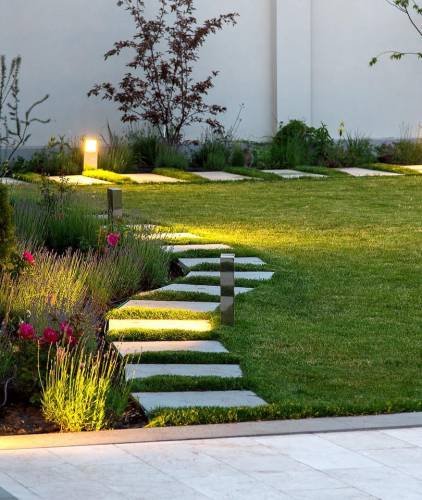
Do You Need a Permit or an Electrician?
- Low-voltage (12V) systems — the standard for residential landscape lighting — generally do not require a permit because they use safe, stepped-down power.
- Line-voltage (120V) systems — used for powerful spotlights or distant fixtures — must be installed by a licensed electrician and typically require a permit.
- Adding a dedicated outdoor circuit, if your home lacks a suitable exterior outlet, runs about $300–$800 through a licensed electrician.
Requirements vary by municipality, so confirm with your local building department or let your installer handle it.
Does Landscape Lighting Add Home Value?
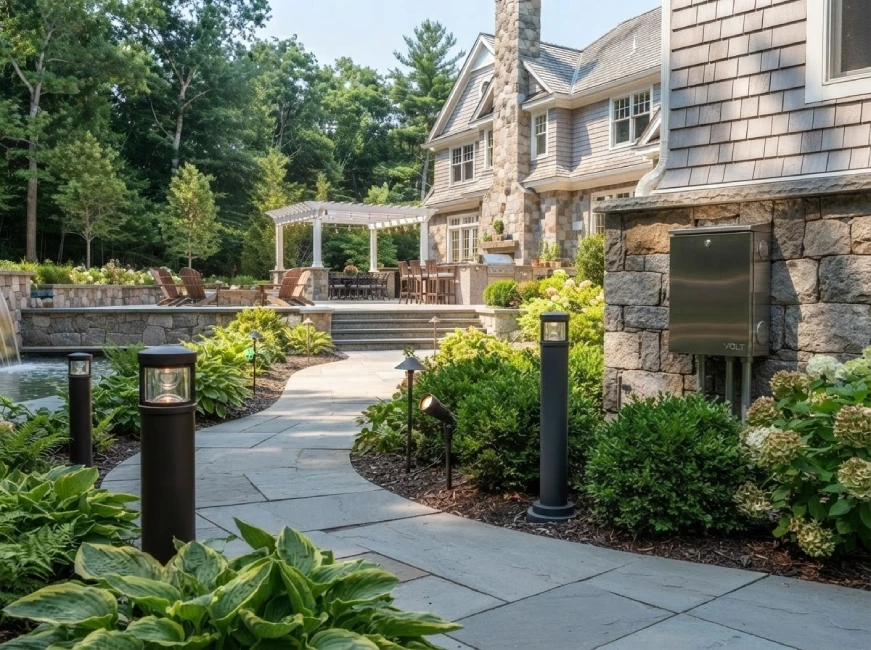
Yes. Professional landscape lighting consistently ranks among the top exterior upgrades for curb appeal and perceived property value — a lit home simply looks more polished, welcoming, and secure from the street at night. It also improves safety and extends the usable hours of your outdoor space, which matters in Massachusetts, where daylight is short for much of the year. Quality installations last up to 15+ years, so the value is long-lived. Because a whole-property system is a meaningful investment, many homeowners use flexible financing to spread the cost.
Ongoing & Maintenance Costs
Landscape lighting upkeep is minimal, especially with LED:
| Task | Frequency | Cost |
| LED bulb replacement | Rare (25,000–50,000 hrs) | Low |
| Re-aiming fixtures as plants grow | Occasional | Low – moderate |
| Cleaning lenses and fixtures | Annual | Low |
| Adjusting timer / photocell for seasons | ~2× per year | Minimal |
Many installers offer maintenance plans that include seasonal adjustments, fixture cleaning, and re-aiming — worth considering to keep the system looking its best.
DIY vs. Professional Landscape Lighting
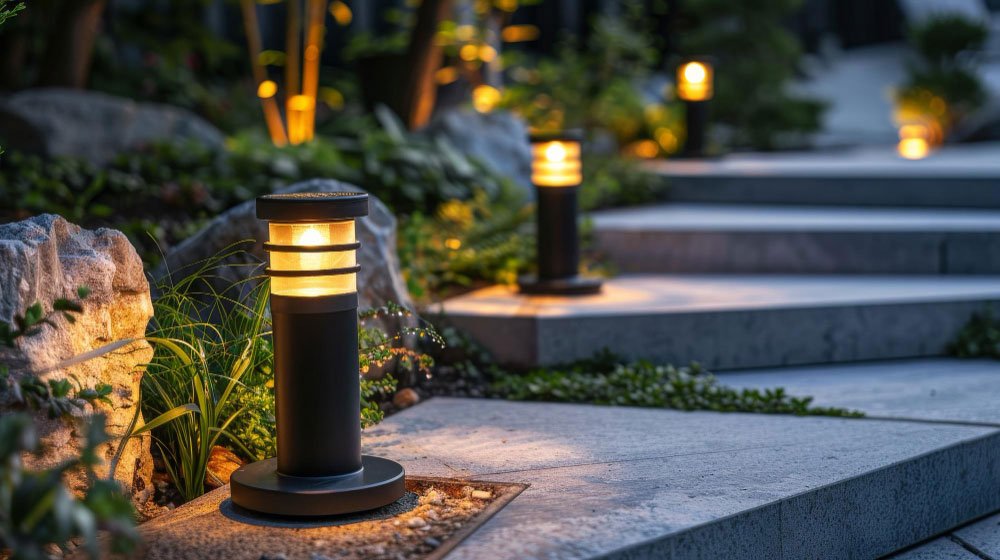
A small solar or plug-in kit for a walkway can be a reasonable DIY project. A full low-voltage system is best left to professionals, and the reasons are technical: correct transformer sizing, wire-gauge selection, voltage-drop calculations, proper burial depth, and weatherproof connections all determine whether the system works reliably and lasts. The most common DIY mistakes are an undersized transformer (causing dimming and early failure) and cheap fixtures that corrode fast. Line-voltage work is also unsafe and illegal to DIY here. A professional also brings design expertise — the difference between a cohesive, intentional look and a random scattering of lights.
Frequently Asked Questions
How much does landscape lighting cost in Massachusetts in 2026? A professional low-voltage LED landscape lighting system in Massachusetts costs $3,000 to $7,000 on average in 2026, or about $100 to $350 per installed fixture. Small starter systems run $800 to $2,500, while large custom whole-property designs with brass fixtures and smart controls reach $10,000 to $20,000 or more.
How much does landscape lighting cost per fixture? Professional-grade landscape lighting costs roughly $100 to $350 per installed fixture in Massachusetts, including the fixture, wiring, and labor. Path lights sit at the lower end, while tree spotlights, well lights, and underwater fixtures cost more. Labor typically accounts for 40 to 60 percent of the total project.
Is solar or low-voltage landscape lighting better for New England? Low-voltage LED is the better choice for New England. Solar fixtures underperform here because short winter days, a low sun angle, and snow cover leave them weakly charged and dim exactly when you need light most. Low-voltage LED systems are reliable year-round and easy to expand.
Do I need a permit for landscape lighting in Massachusetts? Low-voltage (12V) landscape lighting generally does not require a permit. Line-voltage (120V) systems must be installed by a licensed electrician and typically require a permit. Adding a dedicated outdoor circuit also requires an electrician. Requirements vary by municipality, so confirm with your local building department.
Is professional landscape lighting worth it? Yes. Professional landscape lighting boosts curb appeal and perceived property value, improves safety on walkways and steps, and extends the usable hours of your outdoor space — especially valuable in Massachusetts, where winter daylight is short. Quality systems last 15 or more years, making the long-term value strong.
Are LED landscape lights better than halogen? Yes. LED landscape lights use about 75 percent less energy than halogen, run cool, and last 25,000 to 50,000 hours versus a couple thousand for halogen. The upfront cost difference is small, but the lifetime savings in energy and replacements are substantial, which is why LED is the modern standard.
What is the most important part of a landscape lighting system? Two things: fixture quality and the transformer. Solid brass fixtures last decades in New England’s salt air and freeze-thaw, while cheap plated fixtures corrode in a few years. A correctly sized transformer — rated 20 to 50 percent above the total fixture load — prevents the dimming and early failure that plague amateur installs.
How long does landscape lighting last? A quality professional system lasts 15 or more years, with solid brass fixtures lasting 15 to 25 years and LED bulbs rated for 25,000 to 50,000 hours. Longevity depends heavily on fixture quality and proper installation, which is why professional-grade brass and correct wiring matter in our climate.
Why Choose The Pros, Inc. for Your Massachusetts Landscape Lighting
With 20+ years of experience, The Pros, Inc. designs and installs landscape and outdoor lighting across the North Shore, Essex County, and Middlesex County. We build systems for New England conditions — solid, weatherproof fixtures, correctly sized transformers, proper burial and voltage-drop planning, and smart controls — so your lighting performs beautifully through every season, including our long dark winters.
As a full-service landscape design and outdoor living company, we integrate lighting with your hardscaping, decks, pool areas, and planting for a cohesive result — all from one trusted local team.
Want a real price for lighting your property? Get a free, no-obligation consultation and design.
📞 Call (857) 574-4380 or request your lighting consultation online.
The Pros, Inc. Landscaping Company MA