An outdoor kitchen is one of the most rewarding upgrades you can add to a Massachusetts home — but the price range is wide, and most cost guides online quote warm-climate numbers that don’t reflect what it actually takes to build one that survives a New England winter. Between freeze-thaw-rated materials, proper winterized plumbing, and the masonry and utility work involved, a Massachusetts outdoor kitchen is closer to a small home renovation than a backyard accessory. This 2026 guide breaks down exactly what to budget — by tier, by component, and by the New England factors that drive the cost.
In 2026, most Massachusetts homeowners spend $15,000 to $35,000 on a built-in outdoor kitchen. Basic grill islands start around $8,000 to $15,000, while luxury custom builds with a pizza oven, bar, premium appliances, and a covered pavilion run $40,000 to $80,000+. The grill and appliances alone typically account for 30–50% of the budget.
Key Takeaways
- Typical cost: $15,000–$35,000 for a quality built-in outdoor kitchen in Massachusetts (2026).
- Per linear foot: roughly $700–$1,800 for a custom, freeze-thaw-built kitchen; prefab kits cost less.
- Biggest cost driver: appliances — the grill alone can be 30–50% of the total.
- The New England factor: materials must survive freeze-thaw. Use sealed granite or quartzite counters, concrete-block framing (never wood), and UL-rated 304/316 stainless appliances.
- ROI: outdoor kitchens often return close to 100% of their cost, and appraisers frequently value them similarly to a swimming pool.
How Much Does an Outdoor Kitchen Cost in Massachusetts? (2026)
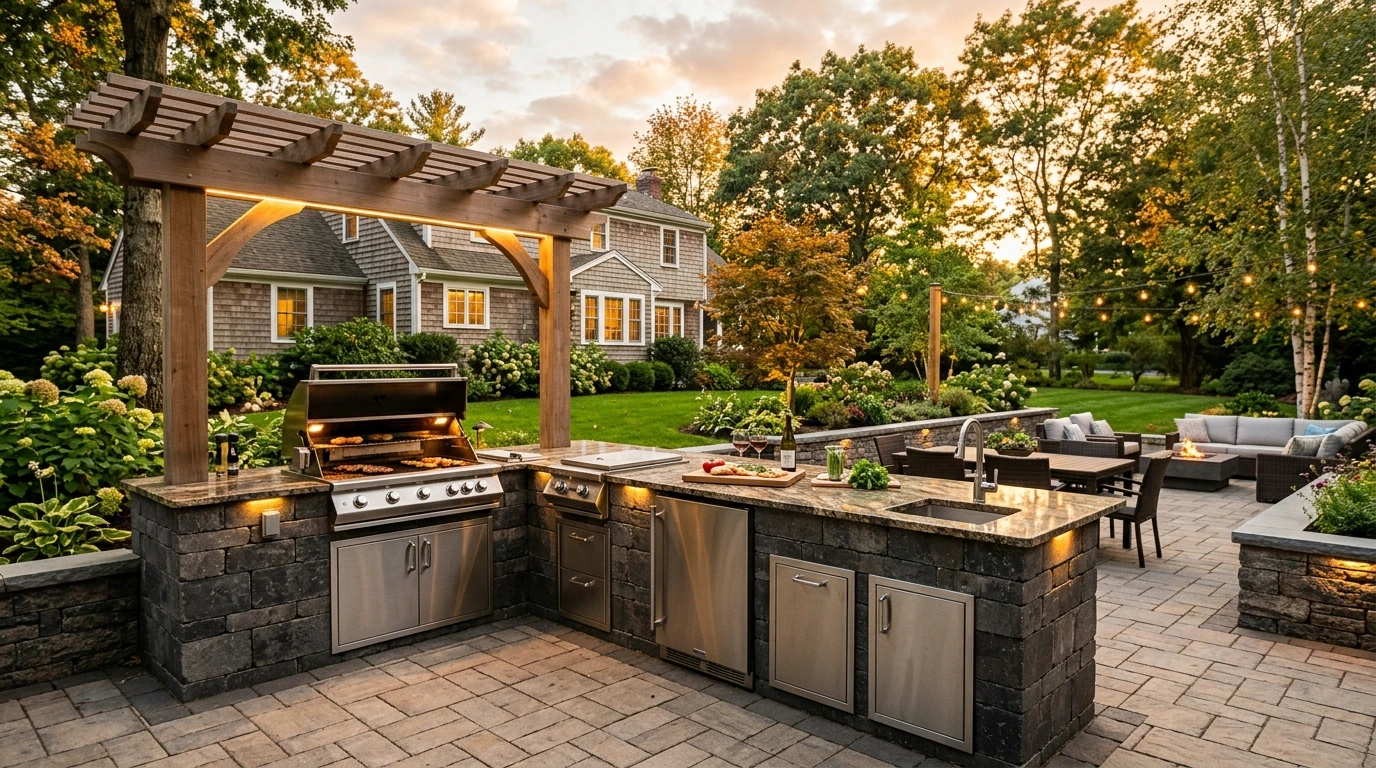
A professionally built outdoor kitchen in Massachusetts costs $15,000 to $35,000 for a typical mid-range setup in 2026. Where you land depends on three things: the appliances you choose, the materials and structure, and how much utility work (gas, water, electrical) your site needs. Here’s how the tiers break down in real dollars.
| Tier | Typical Cost (MA, 2026) | What You Get |
| Basic grill island | $8,000 – $15,000 | Built-in gas grill, counter space, storage; often on an existing patio |
| Mid-range kitchen | $15,000 – $35,000 | Grill + refrigerator + sink, stone countertops, masonry base, utility connections |
| Luxury / custom | $40,000 – $80,000+ | Multiple cooking zones, pizza oven, bar, premium appliances, covered pavilion |
In short: budget around $15,000–$35,000 for a built-in outdoor kitchen that’s done right for the New England climate. You can spend less with a prefab island, or far more with a fully covered outdoor living suite.
By the linear foot, a custom Massachusetts outdoor kitchen built with freeze-thaw-rated materials typically runs $700 to $1,800 per linear foot, while prefab and modular kits come in lower. A standard 10-to-12-foot cooking island is the most common footprint.
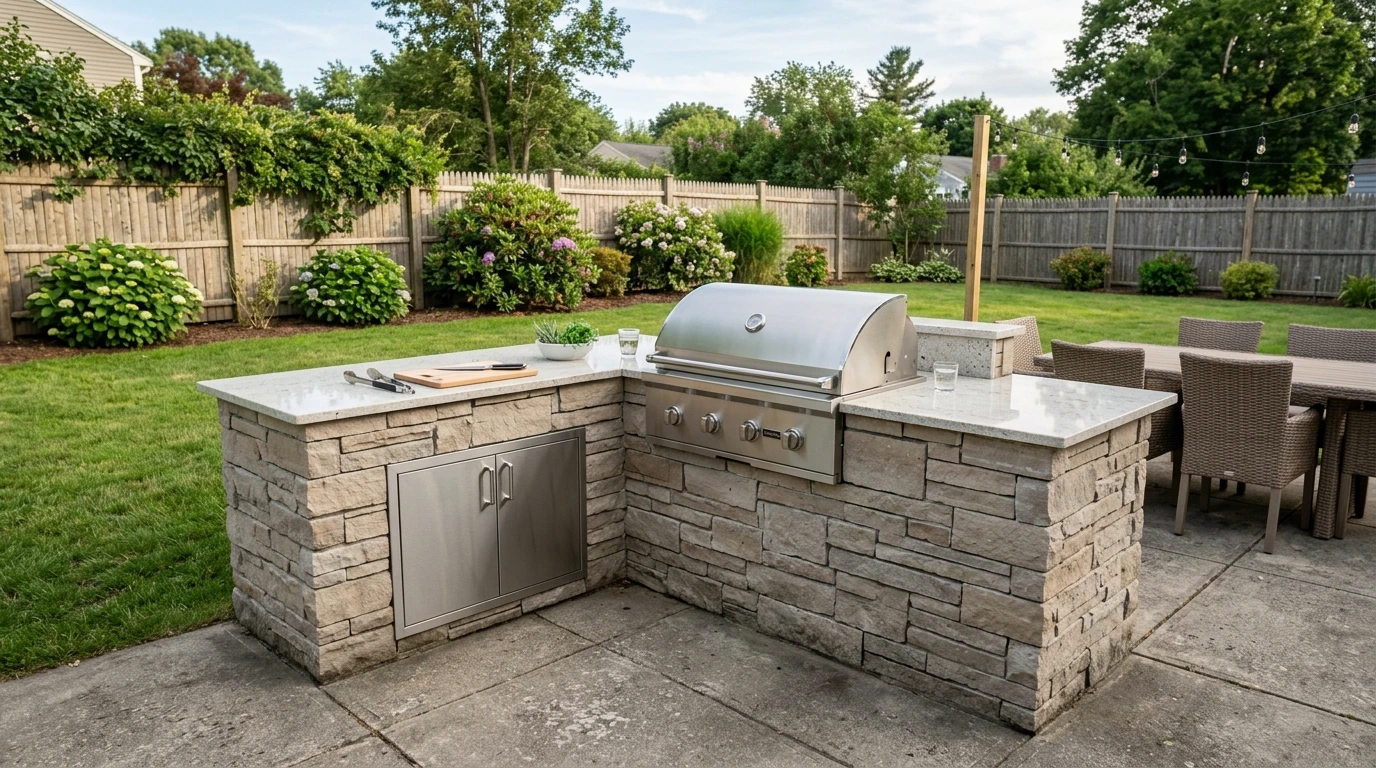
Outdoor Kitchen Cost by Component
The fastest way to understand your budget is to price the kitchen piece by piece. Appliances — especially the grill — are where costs escalate, and where most online estimates fall short. Here are 2026 installed ranges for the major components.
| Component | Typical Cost (Installed) | Notes |
| Built-in gas grill | $1,500 – $10,000+ | 30–50% of the budget; premium brands like Lynx, DCS, Weber Summit |
| Countertops (granite/quartzite) | $50 – $200 / sq ft | ~$1,000–$4,000 for a typical island; sealed for freeze-thaw |
| Cabinetry / framing | $2,000 – $8,000+ | Concrete block + stone veneer, or marine-grade stainless |
| Outdoor refrigerator | $800 – $2,500 | UL-rated, 304-grade stainless |
| Pizza oven | $1,200 – $6,000 | A popular Massachusetts upgrade |
| Sink + plumbing | $800 – $3,000 | Must be winterized with shutoff valves |
| Side burner / smoker / kegerator | $300 – $2,000 each | Choose based on how you cook |
| Foundation / pad | $1,000 – $5,000 | A frost-stable base is essential |
| Gas line (licensed plumber) | $500 – $2,500 | Or skip it with propane |
| Electrical (licensed electrician) | $800 – $3,000 | Outlets, lighting, appliance circuits |
| Permits | $200 – $2,000 | For gas, electrical, and structures |
| Professional design | $500 – $3,000 | Pays for itself in avoided mistakes |
The single biggest budgeting mistake: spending big on a custom stone island and then dropping in a cheap grill. The appliances are what you touch every time you cook — they deserve the larger share of the budget. A $15,000 island with a $500 grill is a backwards build.
Custom Pool, Patio, Paver Builders - THE PROS, INC
Book a Project Consultation With Us
Thank You!
Your request has been received. Our team will contact you within 24 hours.
Why Outdoor Kitchens Cost More in Massachusetts (The New England Factor)
If a Massachusetts quote runs higher than the national averages you’ve seen online, this is why. Building an outdoor kitchen that lasts decades in New England requires specific materials, construction methods, and weatherproofing that mild-climate builds simply skip. Cutting corners here doesn’t save money — it guarantees cracked counters, rotted framing, and burst pipes within a few seasons.
Freeze-Thaw Is the Enemy
Massachusetts goes through dozens of freeze-thaw cycles each winter, where temperatures swing above and below freezing in a single day. When moisture gets into a porous material, freezes, and expands, it cracks and spalls that material — and repeated cycles accelerate the damage dramatically. Every material choice has to account for this.
Materials That Survive a Massachusetts Winter
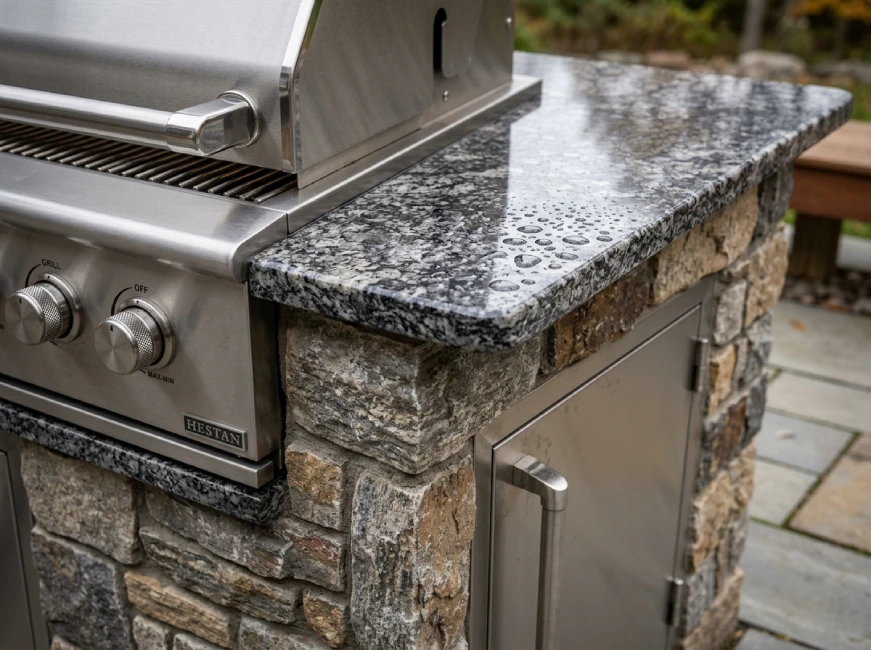
- Countertops: Granite and quartzite are the gold standard — dense, non-porous when properly sealed, and able to handle freeze-thaw without cracking. Avoid marble and tile (grout absorbs water and deteriorates outdoors).
- Framing: Build with concrete block or steel stud — never wood. Wood holds moisture, rots, and attracts pests. Concrete block is essentially maintenance-free and supports heavy stone veneer and appliances. Standard cement board also struggles under repeated New England freeze-thaw stress, which is why high-performance concrete and HDPE are favored in premium builds.
- Flooring: Concrete pavers (such as Belgard) flex slightly with ground movement, making them far more crack-resistant than poured concrete slabs in freeze-thaw conditions.
- Appliances: Look for UL-rated outdoor appliances in 304- or 316-grade (marine) stainless steel, which resist rust and corrosion in our damp climate.
Propane Is Often the Smarter Fuel
In New England, propane is frequently the most practical fuel. It works reliably in cold weather, doesn’t require running a gas line from the house (saving $500–$2,500), and lets your kitchen operate independently of your home’s systems. If you already have natural gas, a licensed plumber can extend a line during the build.
The bottom line: roughly the entire long-term durability of an outdoor kitchen in Massachusetts comes down to material selection and construction method. This is the clearest reason to hire an experienced local builder rather than chase the lowest bid — getting the materials wrong in our climate can ruin a kitchen in a single season.
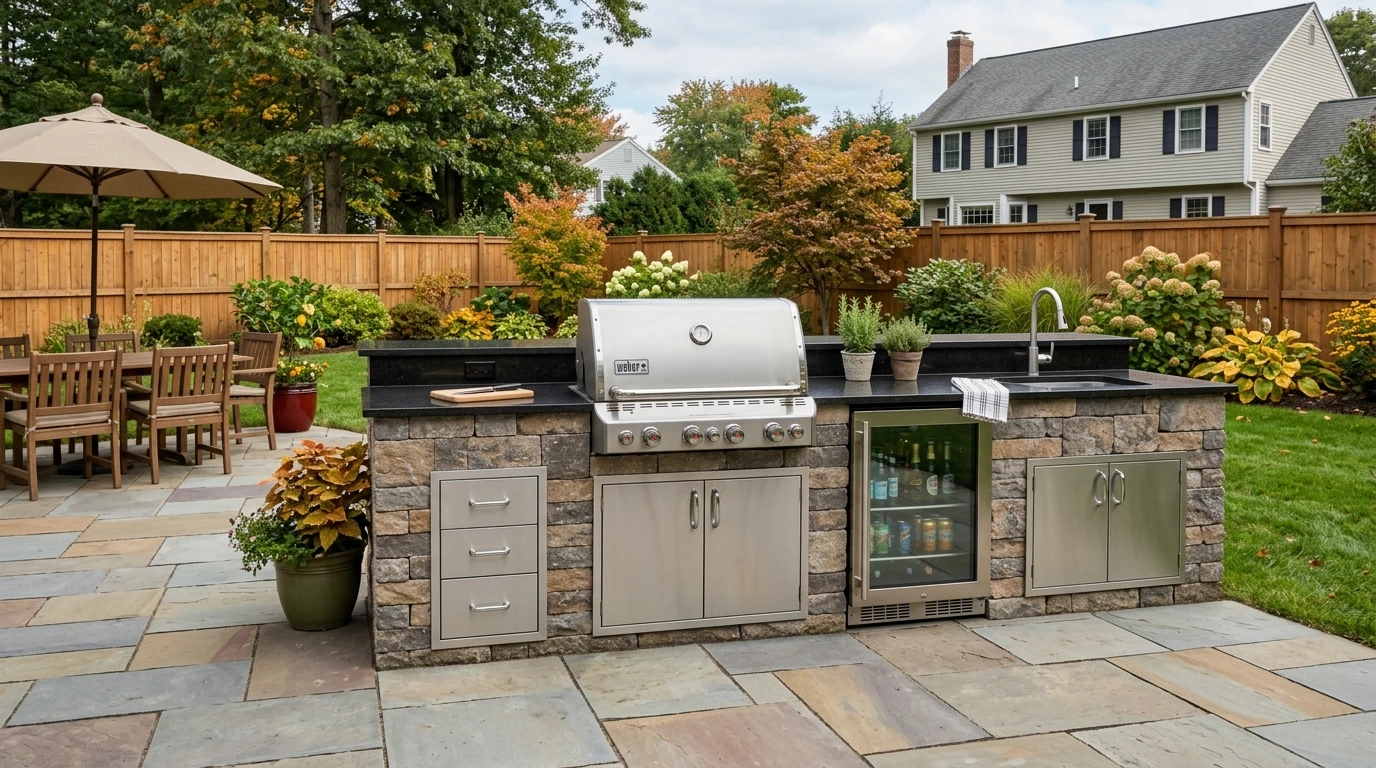
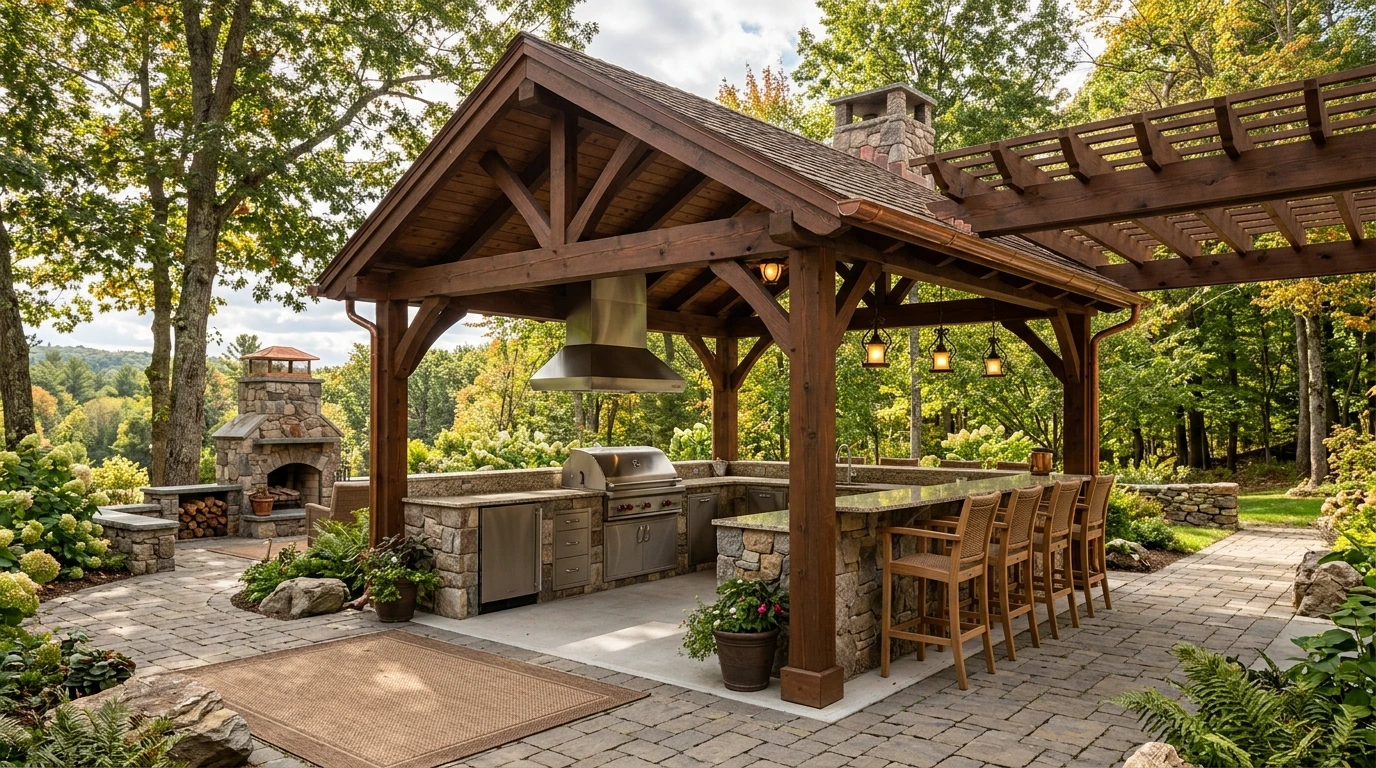
Covered Structures: Extending Your Season in New England
Because Massachusetts has a shorter outdoor season, many homeowners invest in a structure that protects the kitchen and stretches its usability. This is one of the biggest optional cost drivers — and one of the most valuable.
| Structure / Feature | Typical Cost (MA, 2026) |
| Pergola | $4,000 – $12,000+ |
| Pavilion / roofed structure | $10,000 – $40,000+ |
| Vent hood (required under a roof) | $2,000 – $6,000 |
| Built-in outdoor fireplace | $5,000 – $20,000 |
| Fire pit | $1,500 – $6,000 |
| Patio expansion | $1,500 – $5,000+ |
| Infrared / patio heaters | $200 – $2,000 |
| Bar seating area | $2,000 – $10,000+ |
A gazebo or pavilion with wind protection and heating elements can push your hosting season well into the colder months. One important code note: if you build a grill under a roof or solid structure, you’ll need a vent hood to safely exhaust smoke and heat — that’s a required line item, not an optional upgrade.
Utilities, Permits & Licensed Trades in Massachusetts
Most permanent outdoor kitchens in Massachusetts require permits, and certain work must legally be done by licensed trades. A full-service builder handles all of this, but here’s what’s involved:
- Building permits are typically required for permanent structures, gas lines, electrical work, and any roof or pavilion. Costs and requirements vary by municipality, so confirm with your local building department early.
- Gas work must be done by a Massachusetts-licensed plumber/gas fitter, and electrical work by a licensed electrician — this is not DIY-eligible.
- Drainage and grading are major early decisions. Water has to move away from the kitchen and your home’s foundation, especially before winter.
Skipping permits can cause fines, failed inspections, and problems when you sell — another reason to work with a contractor who manages compliance as part of the project.
Do Outdoor Kitchens Add Home Value in Massachusetts?
Yes — and the return is strong. Industry research consistently shows outdoor kitchens returning close to 100% of their cost at resale, and home appraisers frequently value them similarly to a swimming pool, often at a fraction of a pool’s price. In Massachusetts, where homeowners want to maximize a shorter outdoor season, a well-built outdoor kitchen is a genuine selling point and a hub for entertaining.
The strongest returns come from quality construction, durable freeze-thaw materials, and a design that integrates the kitchen into a complete outdoor living space — connected to patios, lighting, and planting — rather than a standalone island marooned in the middle of the yard. Because it’s a significant investment, many homeowners use flexible financing to spread the cost into manageable monthly payments.
Ongoing Maintenance & Winterization Costs
Outdoor kitchen upkeep in Massachusetts is mostly seasonal, and most of it is low-cost if you stay on top of it. Budget for:
- Annual sealing of granite, quartzite, and stone surfaces before winter — essential in a freeze-thaw climate to prevent moisture absorption.
- Winterization each fall: shutting off and draining water lines (often blowing them out with compressed air), shutting off the gas, and covering or removing appliances not rated for winter exposure. This step is the difference between simple spring maintenance and major repairs.
- Routine cleaning of countertops, the grill, and surrounding pavers, plus clearing leaves and debris that trap moisture and stain surfaces.
Done consistently, these small steps protect a five-figure investment and keep the kitchen looking new for decades.
How to Save Money on Your Massachusetts Outdoor Kitchen
You can control costs without compromising the durability that matters in New England:
- Build a “perimeter” kitchen near the house. Locating it near your back door — sharing utilities with the home — dramatically cuts gas, water, and electrical run costs versus a standalone kitchen in the middle of the yard.
- Prioritize appliances over showpiece masonry. Spend where you’ll feel it every cookout.
- Phase the build. Start with the patio and core cooking station built to a high standard, then add a pizza oven, bar, or pavilion later as budget allows.
- Consider propane to skip the cost of running a natural gas line.
- Use mid-tier durable materials — sealed granite and concrete block deliver longevity without top-of-market pricing.
- Bundle the hardscaping, patio, and kitchen into one project so you’re not paying twice for mobilization and site work.
- Invest in a 3D design rendering first to lock in the layout and avoid costly changes mid-build.
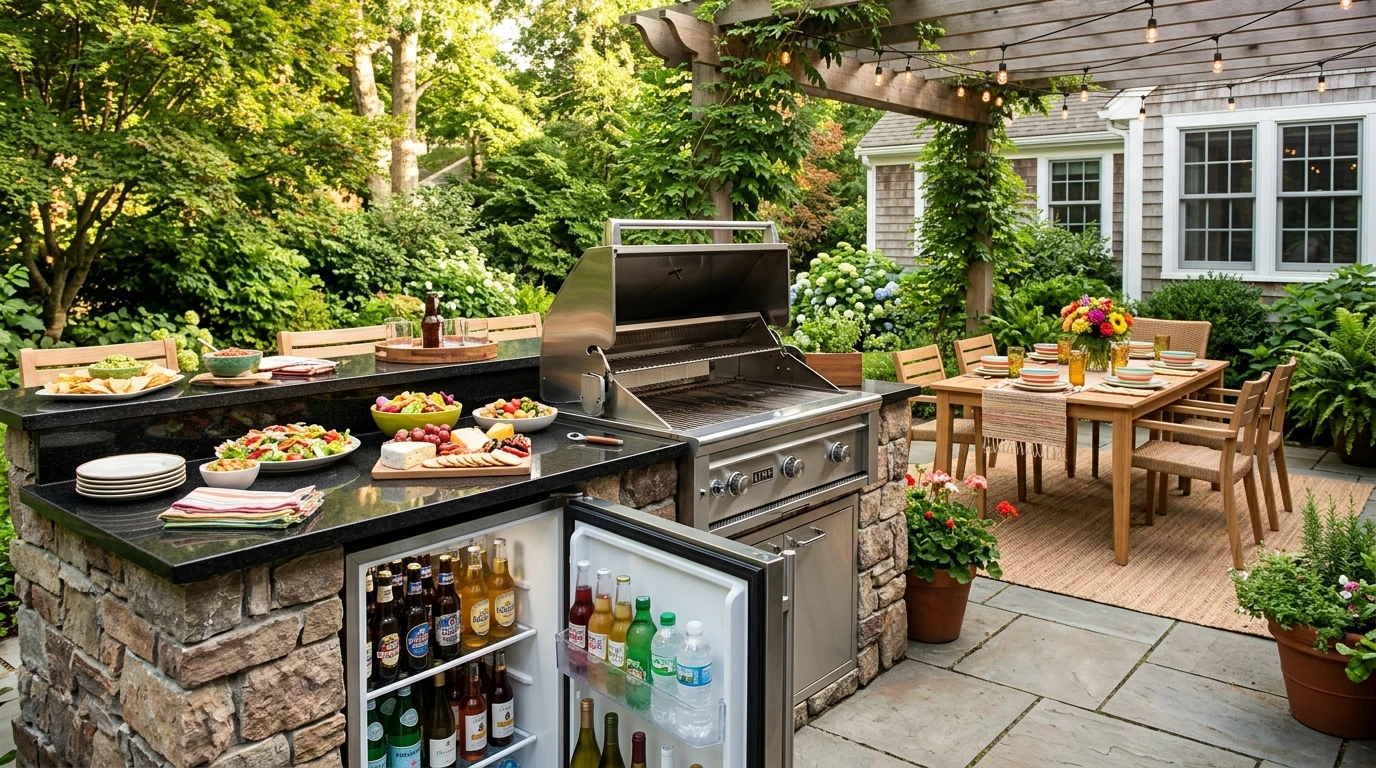
DIY vs. Professional Outdoor Kitchen Installation
A simple prefab grill island on an existing patio can be a reasonable DIY project. A full built-in outdoor kitchen in Massachusetts is not — and the reasons are specific to our climate and code. The failure points for DIY builds are almost always wrong materials (wood framing, unsealed or porous stone), an inadequate frost-stable foundation, and un-permitted gas or electrical work that’s both unsafe and illegal here. Mistakes can void appliance warranties and cost far more to fix than to build correctly the first time.
A professional design-build team brings freeze-thaw construction knowledge, licensed gas and electrical trades, permit management, proper drainage, and the ability to integrate the kitchen with patios, walls, and covered structures. In New England, that expertise is the line between a kitchen that lasts 20+ years and one that fails fast.
Frequently Asked Questions
How much does an outdoor kitchen cost in Massachusetts in 2026? Most Massachusetts homeowners spend $15,000 to $35,000 on a built-in outdoor kitchen in 2026. Basic grill islands start around $8,000 to $15,000, and luxury custom builds with premium appliances, a pizza oven, a bar, and a covered pavilion can run $40,000 to $80,000 or more.
What is the most expensive part of an outdoor kitchen? Appliances are the biggest cost driver, and the grill alone typically accounts for 30 to 50 percent of the budget. A mid-range built-in gas grill runs $1,500 to $5,000, while premium brands like Lynx, DCS, or Weber Summit can cost $5,000 to $10,000 or more.
How much does an outdoor kitchen cost per linear foot? In Massachusetts, a custom outdoor kitchen built with freeze-thaw-rated materials typically costs $700 to $1,800 per linear foot. Prefabricated and modular kits cost less per linear foot but often exclude appliances and finishing work.
What materials hold up best for an outdoor kitchen in New England? Granite and quartzite countertops (properly sealed), concrete-block or steel framing instead of wood, concrete pavers for flooring, and UL-rated 304- or 316-grade stainless steel appliances all withstand Massachusetts freeze-thaw cycles. Avoid wood framing, marble, and tile grout, which absorb moisture and deteriorate quickly outdoors.
Should I use propane or natural gas in Massachusetts? Propane is often the most practical choice in New England because it works in cold weather and doesn’t require running a gas line from the house, saving $500 to $2,500. If you already have natural gas at the home, a licensed plumber can extend a line during the build.
Do I need a permit to build an outdoor kitchen in Massachusetts? Usually, yes. Permits are typically required for gas lines, electrical work, and structures like roofs or pavilions, and requirements vary by municipality. Gas work must be done by a licensed plumber and electrical work by a licensed electrician. A design-build team manages permits and code compliance for you.
Do outdoor kitchens add value to your home? Yes. Outdoor kitchens often return close to 100 percent of their cost at resale, and appraisers frequently value them similarly to a swimming pool. They’re a strong selling point in Massachusetts, where homeowners want to make the most of a shorter outdoor season.
Can I use an outdoor kitchen year-round in Massachusetts? Full winter use is uncommon, but covered structures, wind protection, and heating elements like infrared heaters can extend the season well into the colder months. Proper winterization — draining water lines, sealing stone, and covering appliances — protects the kitchen during the months it’s not in use.
How long does it take to build an outdoor kitchen? Most outdoor kitchen builds take about two to three weeks, while larger projects with multiple features, masonry, and a covered structure can take three to five weeks or more. Permitting, weather, and site conditions affect the timeline.
Why Choose The Pros, Inc. for Your Massachusetts Outdoor Kitchen
With 20+ years of experience, The Pros, Inc. designs and builds outdoor kitchens and complete outdoor living spaces across the North Shore, Essex County, and Middlesex County. We engineer every kitchen for New England conditions — frost-stable foundations, freeze-thaw-rated materials, sealed natural-stone countertops, concrete-block construction, and properly winterized utilities — so your investment performs for decades, not seasons.
As a full-service outdoor living and hardscaping company, we handle everything from 2D/3D design and permitting to masonry, appliances, fire features, pergolas and pavilions, lighting, and surrounding hardscaping — all from one trusted local team. The result is a cohesive, durable, code-compliant backyard built for the way you actually entertain.
Want a real, itemized price for your outdoor kitchen? Get a free, no-obligation consultation and quote.
📞 Call (857) 574-4380 or request your outdoor kitchen design consultation online.
The Pros, Inc. Hardscaping Company MA