Planning a paver patio in Massachusetts and want a real number before you call a contractor? Patio pricing here is not the same as the national averages floating around online — our clay-heavy soil, deep frost line, and freeze-thaw winters demand a deeper, more engineered base, and that directly affects what you pay. This 2026 guide breaks down paver patio costs in Massachusetts by the square foot, by material, and by everything that lands on a real quote, so you can budget with confidence.
Quick Answer: In 2026, a professionally installed paver patio in Massachusetts costs $18 to $45 per square foot, with most homeowners spending $22 to $35 per square foot. A typical 400-square-foot patio runs roughly $9,000 to $16,000, depending on the paver material, site conditions, and add-ons like borders, steps, or a fire pit.
Key Takeaways
- Average cost: $18–$45 per square foot installed in Massachusetts (2026); $22–$35 is the typical mid-range.
- By project size: ~$2,600–$6,500 for a small 12×12 patio; ~$9,000–$16,000 for a 20×20.
- Biggest cost drivers: base preparation, labor, and site/drainage conditions — not just the pavers themselves.
- The New England factor: patios here need a 6–8 inch compacted gravel base (vs. ~4 inches in warm climates) to survive frost heave, which raises labor and material costs but prevents failure.
- ROI: a quality paver patio typically returns 50–75% of its cost in added home value.
How Much Does a Paver Patio Cost in Massachusetts? (2026)
A paver patio in Massachusetts costs $18 to $45 per square foot installed in 2026. Where you land in that range depends mostly on the paver material you choose and the condition of your site. Simple concrete-paver rectangles on flat, well-draining ground sit at the low end; natural stone, intricate patterns, premium designer brands, or yards with grading and drainage problems push toward the top.
Here is what that means in real dollars for common patio sizes:
Patio Size | Square Feet | Typical Installed Cost (MA, 2026) |
10 × 12 | 120 sq ft | $2,200 – $5,400 |
12 × 12 | 144 sq ft | $2,600 – $6,500 |
12 × 16 | 192 sq ft | $3,500 – $8,600 |
16 × 20 | 320 sq ft | $5,800 – $14,000 |
20 × 20 | 400 sq ft | $7,200 – $18,000 |
In short: Most Massachusetts homeowners budget around $22–$35 per square foot for a quality, professionally installed paver patio — and the final number is decided as much by what’s under the pavers as by the pavers themselves.
These figures include materials, labor, base preparation, and basic grading. They do not include major extras like demolition of an existing patio, retaining or seating walls, fire features, or significant drainage work — all covered further down.
Paver Patio Cost by Material
The material you choose is the single biggest variable in your patio budget. Below are 2026 installed price ranges for the most common paver materials in Massachusetts, from most affordable to premium.
Material | Installed Cost / Sq Ft | Best For |
| Stamped concrete | $12 – $20 | Lowest upfront cost (note: prone to cracking, hard to repair) |
| Concrete pavers (standard) | $15 – $30 | Best all-around value; huge style range, easy repairs |
| Brick pavers | $16 – $28 | Classic New England look; timeless and durable |
| Bluestone (natural) | $20 – $35 | Locally quarried Northeast favorite that ages beautifully |
| Flagstone | $18 – $38 | Natural, irregular look; needs skilled fitting |
| Premium pavers (Techo-Bloc, Unilock, Cambridge, Belgard, Nicolock) | $25 – $45+ | Designer textures and strong manufacturer warranties |
| Permeable pavers | $20 – $40 | Stormwater management and drainage-sensitive lots |
| Granite | $25 – $50+ | The hardest, longest-lasting option — lasts generations |
Concrete pavers are the most popular choice in Massachusetts because they balance cost, durability, and design flexibility, and individual units can be lifted and reset if one is ever stained or damaged. Bluestone is the regional favorite among natural stones — it’s quarried in the Northeast, so it suits the local aesthetic and avoids long-haul shipping costs. Premium brands like Techo-Bloc, Unilock, and Cambridge cost more per square foot but offer advanced surface finishes, tighter color consistency, and warranties that matter for a long-term investment.
What’s Actually Included in a Paver Patio Quote?
When you see a per-square-foot price, several components are bundled inside it. Understanding the breakdown helps you compare quotes apples-to-apples and spot a bid that’s cutting corners on the part that matters most — the base.
Cost Component | Typical Cost / Sq Ft | Share of Project |
Pavers (material) | $4 – $12+ | Varies by material |
Installation labor | $6 – $13 | 30–50% of total |
Base preparation (gravel + compaction) | $2 – $5 | Critical in MA |
Excavation / dig-out | $1 – $5 | Depends on soil |
Edge restraints + polymeric sand | Usually included | Locks the patio in |
The two line items that move a quote the most are base preparation and labor — not the pavers. A beautiful, expensive paver laid on a shallow or poorly compacted base will fail within a few seasons in Massachusetts. That’s exactly why the next section matters so much
Custom Pool, Patio, Paver Builders - THE PROS, INC
Book a Project Consultation With Us
Thank You!
Your request has been received. Our team will contact you within 24 hours.
Why Paver Patios Cost More in Massachusetts (The New England Factor)
If a Massachusetts quote looks higher than a national average you found online, this is usually why. Building a patio that survives New England winters requires more excavation, more base material, and more skilled labor than building one in a mild climate. Here’s what drives that.
Clay-Heavy Soil That Drains Poorly
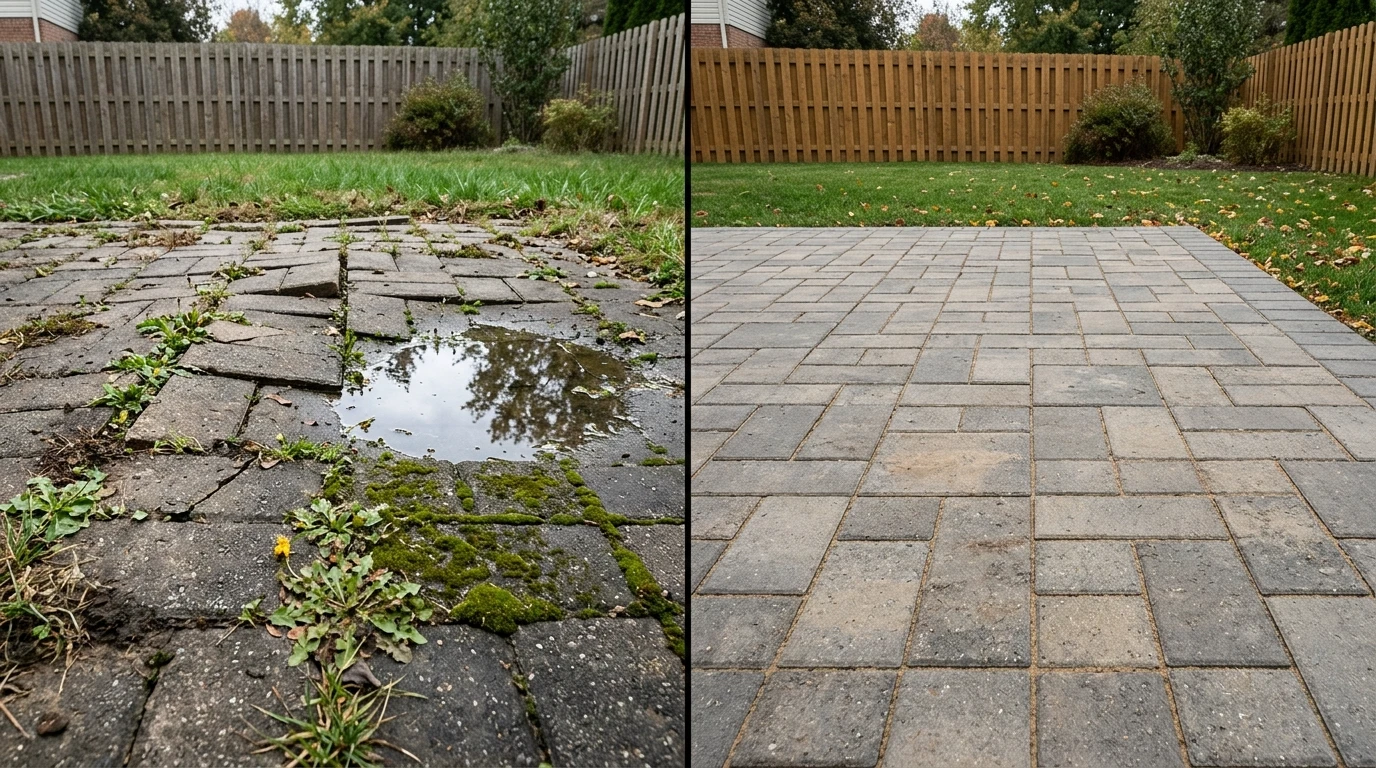
Much of Massachusetts sits on dense, clay-rich soil that holds water instead of letting it drain. Saturated soil under a patio freezes, expands, and heaves the surface unevenly. Proper installation often requires a geotextile fabric between the soil and gravel, plus engineered drainage — work that cheaper “drop pavers on sand” approaches skip entirely.
A Deep Frost Line and Freeze-Thaw Cycles
Massachusetts experiences dozens of freeze-thaw cycles each winter, and the frost line runs several feet deep. When water trapped beneath a patio freezes, it lifts the pavers; when it thaws, they settle unevenly. The defense is a properly engineered base.
The 6–8 Inch Base Requirement
This is the technical heart of the cost difference. In warm climates, a 4-inch gravel base is often enough. In New England’s freeze-thaw environment, patios require a 6–8 inch compacted crushed-stone base to resist frost heave and stay level year-round. Done correctly, a Massachusetts patio installation looks like this:
- Total excavation of 7–8 inches below the finished grade (to fit the base, bedding, and pavers).
- 6 or more inches of angular crushed stone (such as ¾-inch processed gravel / crusher run), compacted in 2–3 inch lifts rather than dumped all at once.
- A 1-inch bedding layer of coarse sand — never sand alone as the structural base, because it migrates and washes out.
- A mandatory ¼-inch-per-foot slope (about 2%) to drain water away from your home’s foundation.
- Polymeric sand swept into the joints and edge restraints to lock everything in place.
The bottom line: roughly 80% of a paver patio’s long-term success comes from the base, not the surface. “No-dig” or thin-base shortcuts that work in mild regions fail quickly in Massachusetts — which is why proper local installation costs more, and why it’s worth it.
This is also the clearest reason to hire an experienced local installer rather than chase the lowest bid: a contractor who understands New England base depth, soil, and drainage is buying you 20–30 years of stable patio instead of 2–3 years before heaving and re-leveling.
Additional Costs and Popular Upgrades
Most homeowners don’t stop at a plain patio. These are the common add-ons that affect a Massachusetts patio budget in 2026.
Upgrade / Extra | Typical Cost (MA, 2026) |
Demolition of existing patio or concrete slab | $5 – $10 / sq ft |
Decorative border or contrasting banding | $3 – $8 / linear ft |
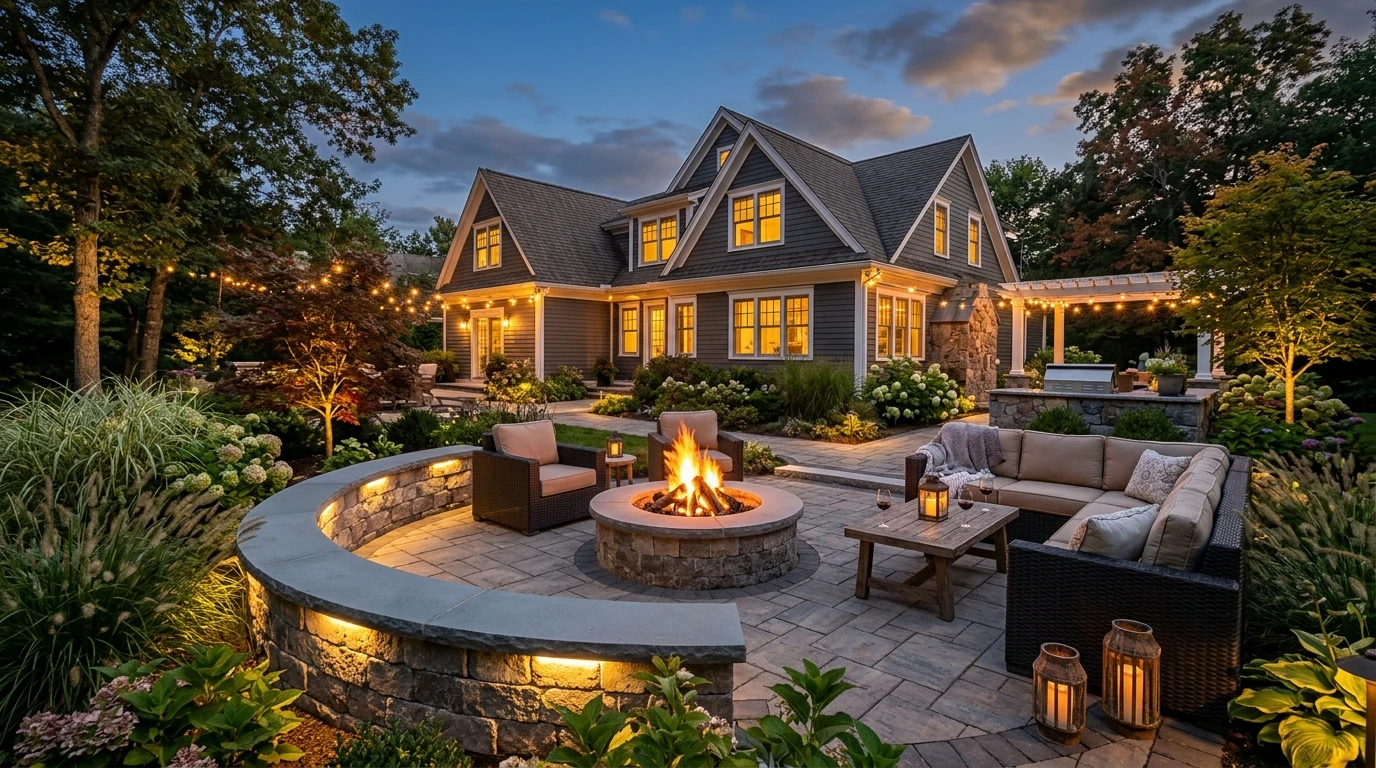
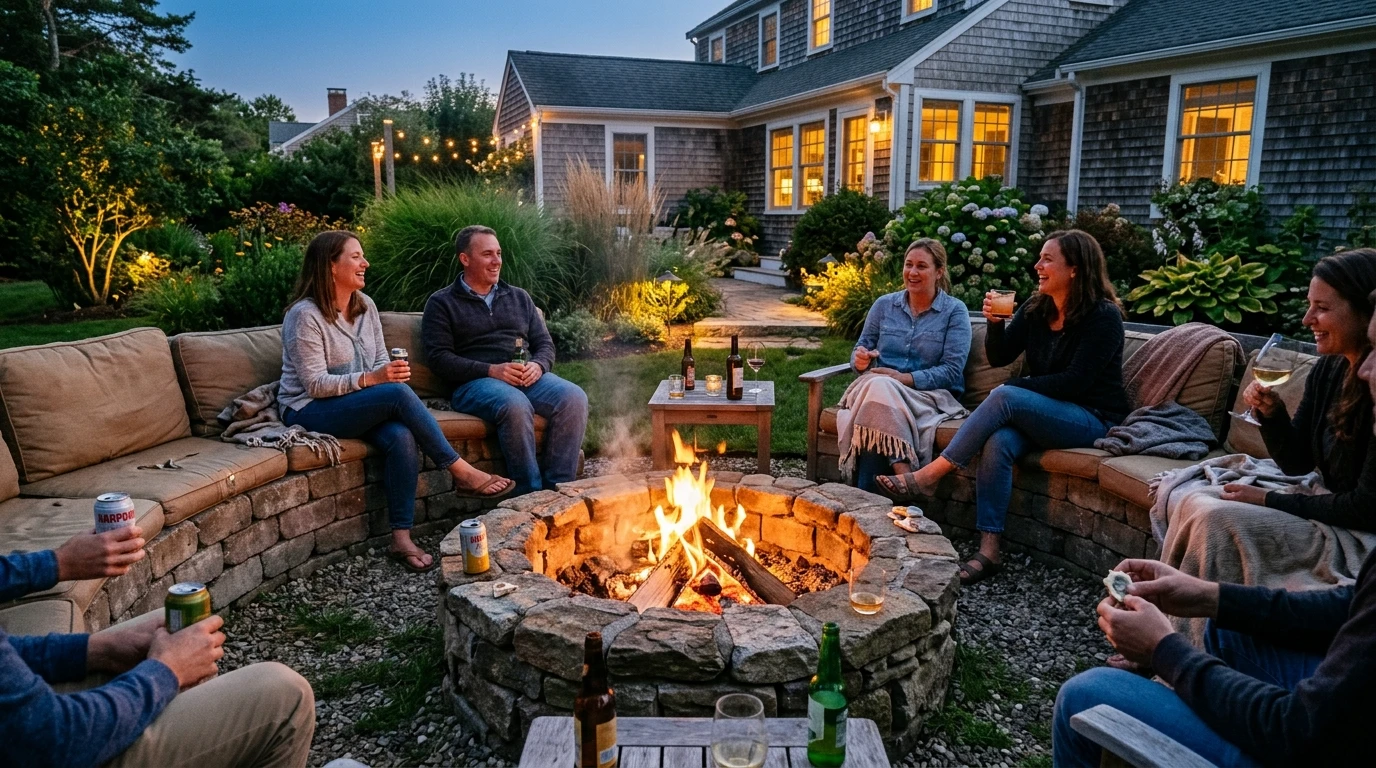
Built-in fire pit | $1,500 – $6,000+ |
Seating wall or retaining wall | $40 – $100+ / linear ft |
Steps and stairs | $300 – $800+ per step |
Patio and landscape lighting | $700 – $2,500+ |
Added drainage (French drain, channel drain) | $1,000 – $5,000+ |
Outdoor kitchen or grill station | $5,000 – $20,000+ |
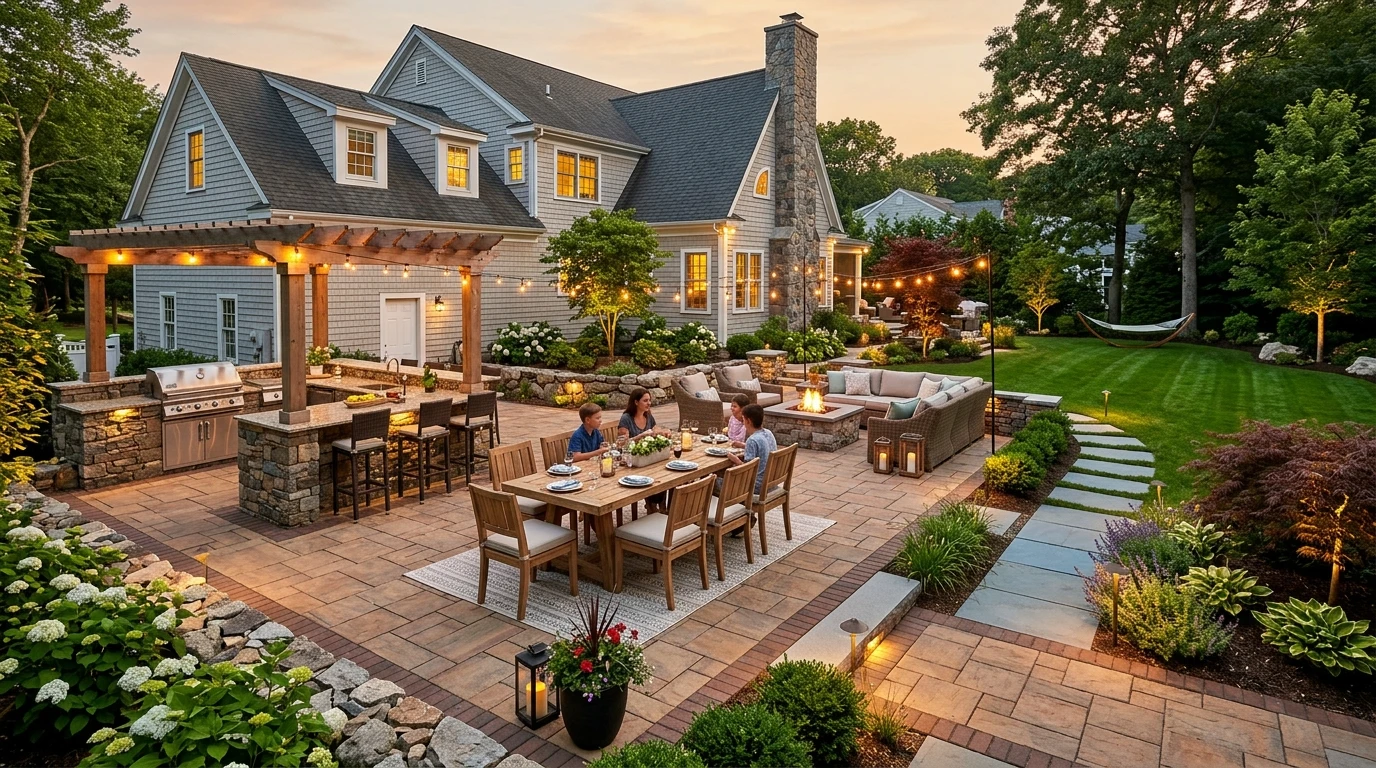
Bundling these into the original build is almost always cheaper than adding them later, because the crew, equipment, and base work are already on site. A patio designed from the start to flow into a complete outdoor living space — with hardscaping, lighting, and planting — delivers far more value than a basic slab of pavers added in isolation.
Paver Patio vs. Stamped Concrete vs. Poured Concrete in MA
A common question: are pavers worth it over concrete? Here’s the honest comparison for a Massachusetts climate.
- Poured concrete is cheaper upfront but cracks under freeze-thaw stress, and a cracked slab is difficult and obvious to repair.
- Stamped concrete ($12–$20/sq ft) mimics the look of pavers or stone but shares concrete’s cracking problem, and color/pattern repairs are nearly impossible to match.
- Pavers cost more initially but flex with ground movement, resist cracking, can be spot-repaired one unit at a time, and generally add more resale value.
For a region with our winters, interlocking pavers are usually the smarter long-term investment — which is why they dominate Massachusetts backyards.
DIY vs. Professional Paver Patio Installation
DIY can make sense for a small, simple walkway on flat, stable ground. For a full patio in Massachusetts, professional installation is strongly recommended, and here’s why: the failure point is almost always the base. Most DIY installations underestimate base material by 10–20%, skip proper compaction in lifts, or use a base that’s too shallow for our frost depth. The result is a patio that heaves, settles, and pools water within a couple of seasons — and fixing a failed patio costs far more than building it right once.
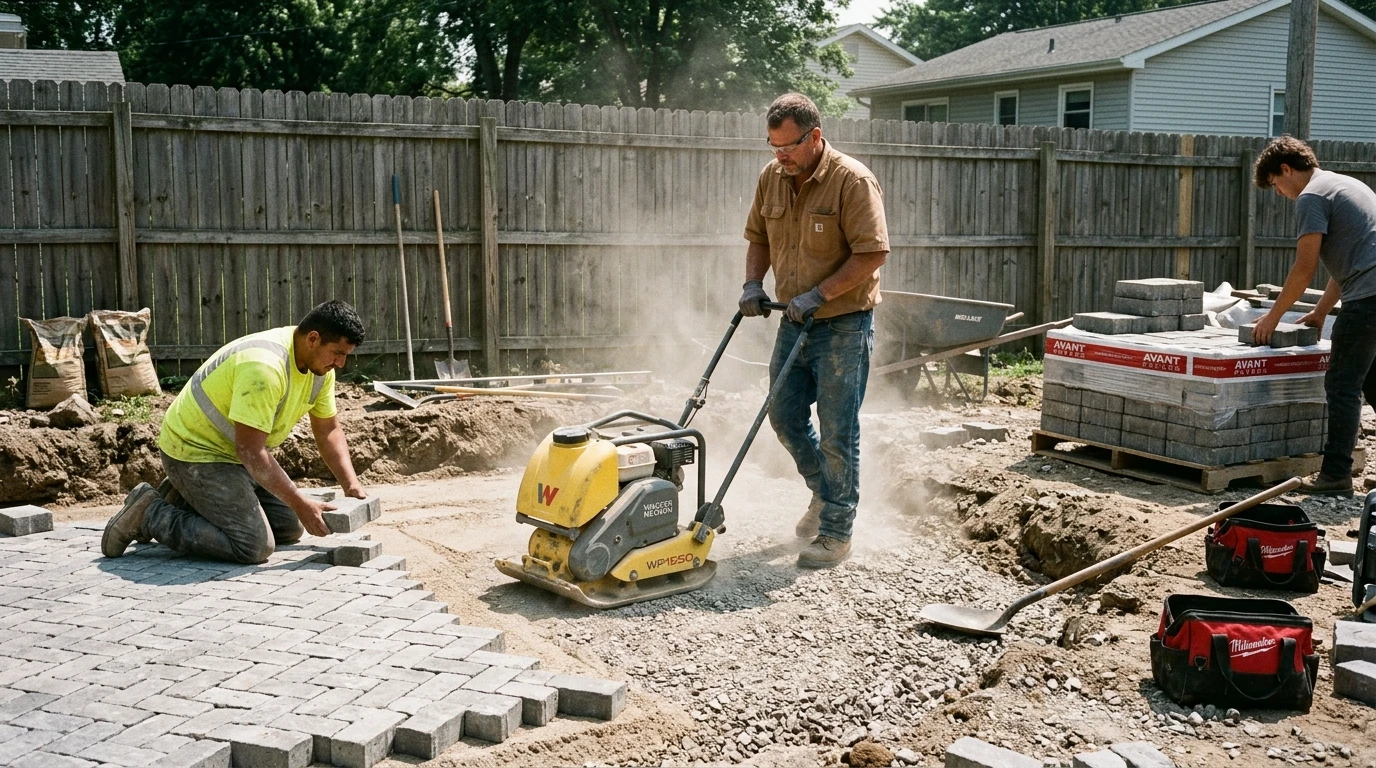
A professional crew brings plate compactors, laser-leveling for correct slope, knowledge of local soil and drainage, and the ability to integrate retaining walls, steps, and drainage correctly. In freeze-thaw country, that expertise is the difference between a patio that lasts decades and one that fails fast.
Do Paver Patios Add Home Value in Massachusetts?
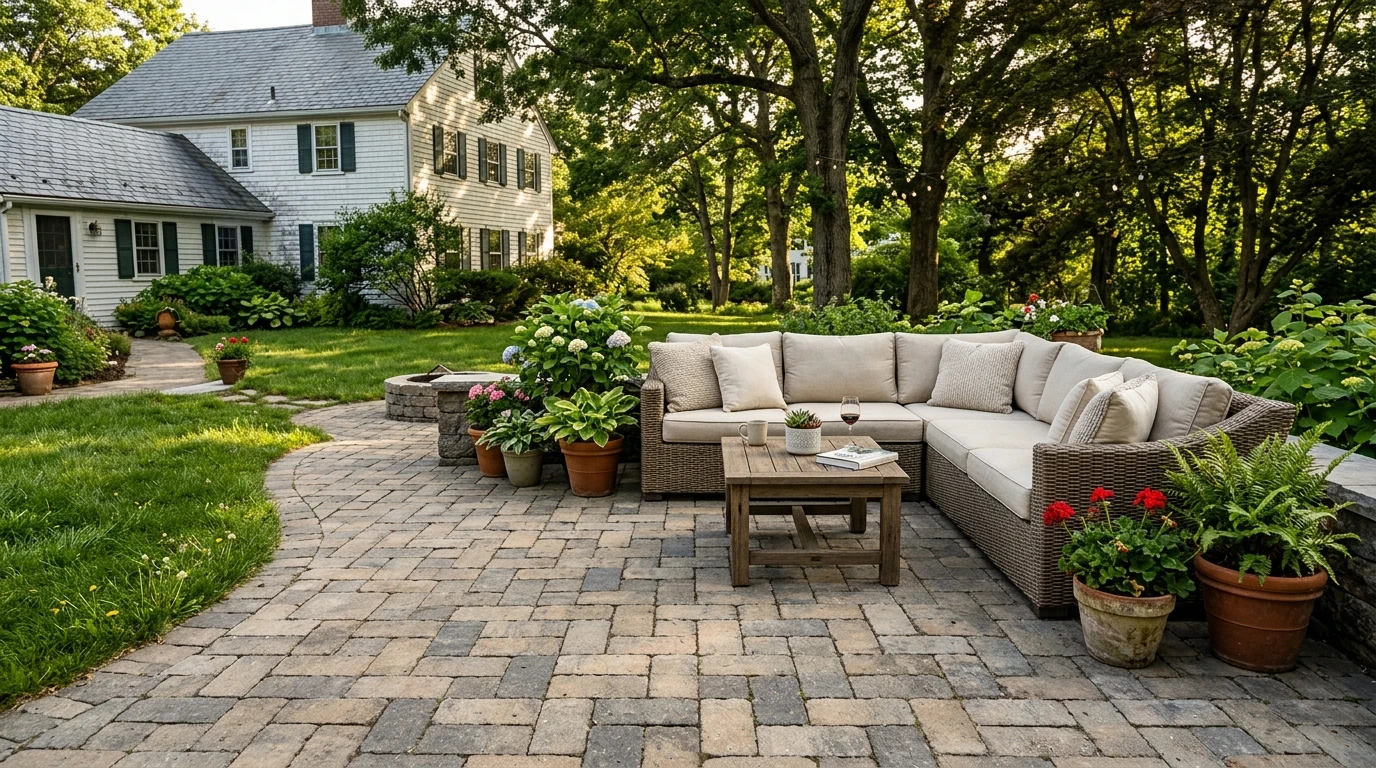
Yes. A well-designed paver patio typically returns 50–75% of its cost in added home value, and it boosts curb appeal and the usability of your outdoor space — a real selling point in Massachusetts, where homeowners want to maximize a shorter outdoor season. The strongest returns come from quality construction, durable materials, and a design that connects the patio to the rest of the yard rather than an oversized installation that overwhelms the property. Because a patio is a meaningful investment, many homeowners use flexible financing to spread the cost into manageable monthly payments.
Ongoing Maintenance Costs
One of the advantages of pavers is low, predictable upkeep. Budget for:
Maintenance Task | Typical Cost | Frequency |
Sealing | $1 – $2 / sq ft | Every 3–5 years |
Re-sanding joints (polymeric sand) | $0.50 – $1 / sq ft | As needed |
Cleaning / power washing | $0.10 – $0.30 / sq ft | Annually |
Sealing isn’t strictly required, but it deepens color, resists stains, and helps lock joint sand in place. Compared to wood decks or stamped concrete, a paver patio’s lifetime maintenance is minimal.
How to Save Money on Your Massachusetts Paver Patio
You can control costs without sacrificing the base quality that makes a patio last:
- Choose standard concrete pavers over premium brands or natural stone — you keep durability while trimming material cost.
- Keep the shape simple. Fewer curves, borders, and cuts mean less labor and less wasted material.
- Plan in the off-season. Designing and booking in fall or winter can secure better scheduling and pricing before the spring rush.
- Bundle all the hardscaping at once so you’re not paying twice for mobilization and base work.
- Never cut corners on the base. The one place to not save money is excavation and base prep — that’s what protects your entire investment.
- Get a 3D design rendering first so you finalize the layout and avoid costly mid-project changes.
Frequently Asked Questions
How much does a paver patio cost in Massachusetts in 2026? A professionally installed paver patio in Massachusetts costs $18 to $45 per square foot in 2026, with most homeowners spending $22 to $35 per square foot. A 400-square-foot patio typically runs $9,000 to $16,000, depending on material, site conditions, and add-ons.
What is the cheapest type of paver patio? Stamped concrete is the lowest upfront cost at $12 to $20 per square foot, and standard concrete pavers are the most affordable true paver option at $15 to $30 per square foot installed. Keep in mind stamped concrete is prone to cracking in New England’s freeze-thaw climate and is difficult to repair.
Why are paver patios more expensive in Massachusetts than the national average? New England’s clay-heavy soil and deep frost line require a thicker, engineered base — typically 6 to 8 inches of compacted crushed stone versus about 4 inches in warm climates. That extra excavation, base material, drainage work, and skilled labor raises the cost but prevents frost heave and patio failure.
How deep should a paver patio base be in New England? In Massachusetts, plan on a 6- to 8-inch compacted crushed-stone base, with total excavation of 7 to 8 inches below finished grade to accommodate the base, a 1-inch sand bedding layer, and the pavers. The base should be compacted in 2- to 3-inch lifts and sloped a quarter inch per foot for drainage.
Is a paver patio worth it compared to concrete? For a Massachusetts climate, yes. Pavers flex with ground movement instead of cracking like concrete, can be repaired one unit at a time, and typically add more resale value. Poured and stamped concrete are cheaper upfront but crack under freeze-thaw stress and are hard to repair invisibly.
How long does it take to install a paver patio? Most residential paver patios take a few days to about two weeks, depending on size, demolition, drainage needs, and added features like walls or steps. Weather and site access can affect the timeline.
Do paver patios add value to my home? A quality paver patio generally returns 50–75% of its cost in added home value and improves curb appeal and outdoor usability — a strong selling point in Massachusetts, where a shorter outdoor season makes a great patio especially desirable.
How much maintenance does a paver patio need? Very little. Expect occasional power washing ($0.10–$0.30 per square foot), re-sanding the joints as needed, and optional sealing every 3 to 5 years ($1–$2 per square foot). Pavers require far less upkeep than wood decks or stamped concrete.
What is the best time of year to build a patio in Massachusetts? Spring through fall is the building season, but designing and booking in the off-season (fall or winter) helps you secure better scheduling and pricing and get on the calendar before the spring rush.
Why Choose The Pros, Inc. for Your Massachusetts Patio
With 20+ years of experience, The Pros, Inc. designs and builds paver patios, walkways, and complete outdoor living spaces across the North Shore, Essex County and Middlesex County MA. We engineer every patio for New England conditions — correct base depth, proper compaction, drainage, and slope — so your investment stays level and beautiful for decades, not seasons.
As a full-service hardscaping and landscape design company, we handle everything from 2D/3D design and permitting to pavers, retaining walls, steps, fire features, lighting, and planting — all from one trusted local team. The result is a cohesive, durable, code-compliant backyard built to last.
Want a real, itemized price for your patio? Get a free, no-obligation consultation and quote.
📞 Call (857) 574-4380 or request your patio design consultation online.
The Pros, Inc. Hardscaping Company MA