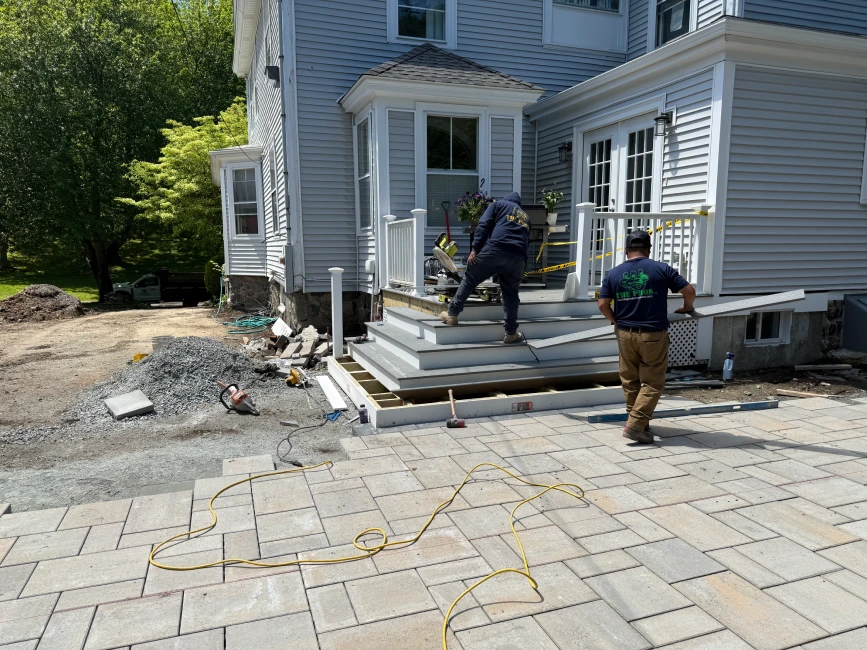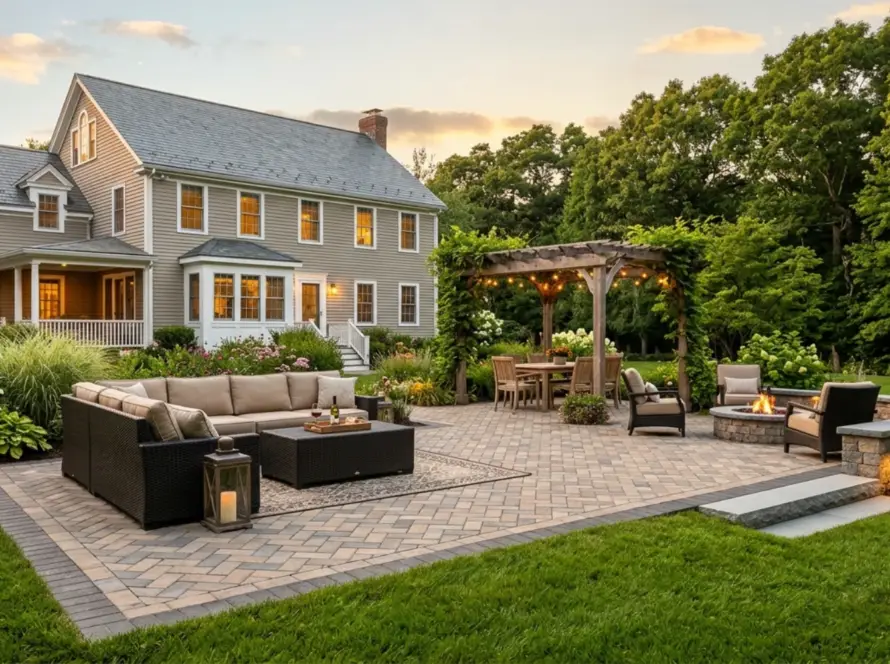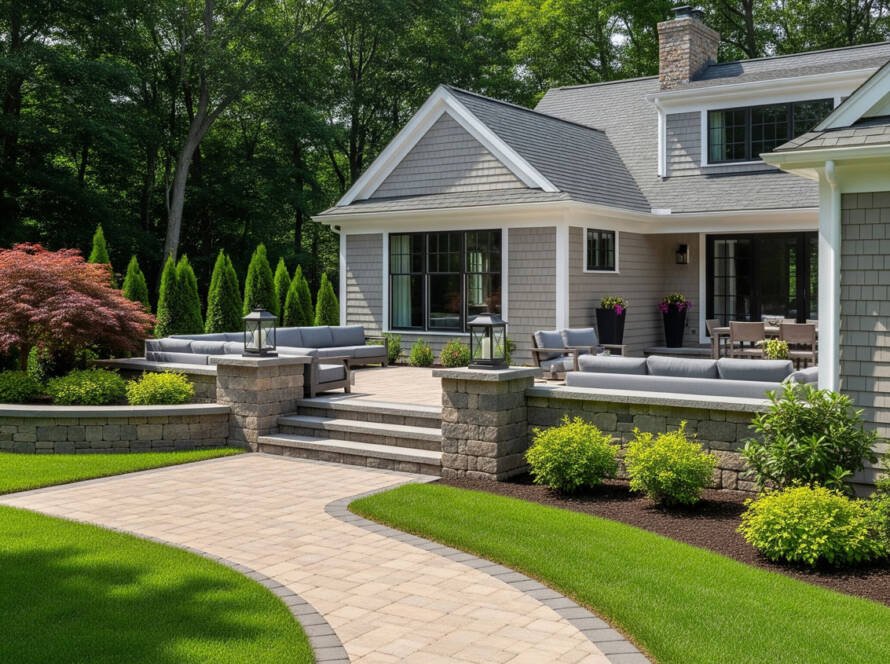
For most flat Massachusetts yards, a paver patio is the better value in the deck vs patio decision. It costs about half as much per square foot, lasts 20 to 30 years, and handles snow and salt well. A deck wins when your back door sits high above the ground or the yard slopes. Many North Shore homes use both.
Key takeaways
- Cost: Paver patios run $18 to $45 per square foot installed. Composite decks run $40 to $80.
- Lifespan: Patios last 20 to 30 years. Composite decks last 25 to 50 years, and wood decks about 15.
- Upkeep: Patios need cleaning and resealing every few years. Wood decks need stain every 2 to 3 years.
- Yard shape: Flat yards favor a patio. Steep slopes and high back doors favor a deck.
- Resale: Decks recoup more of their cost at resale, according to the 2025 Cost vs. Value report.
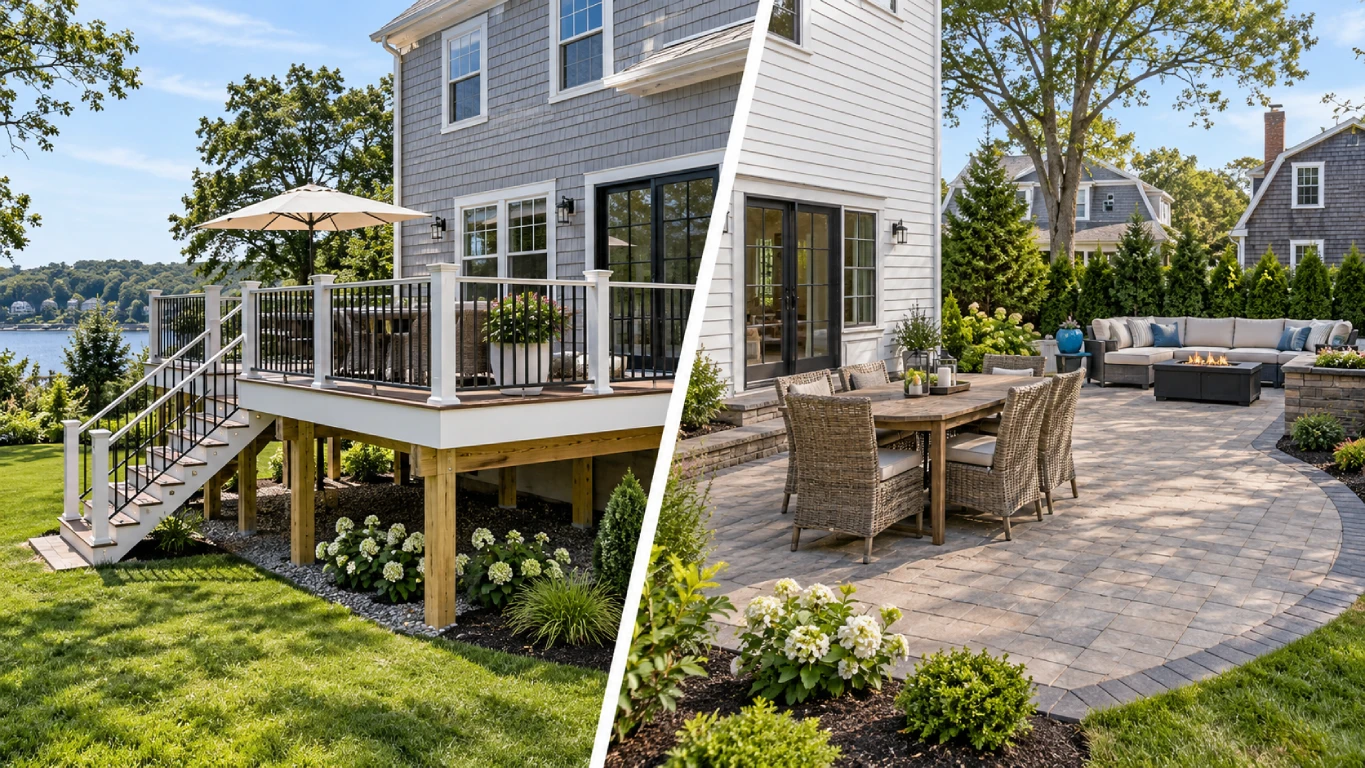
Deck vs Patio at a Glance
This deck vs patio table compares a paver patio with the two most common deck types in Massachusetts. The prices come from our own 2026 cost guides for the North Shore, Essex County, and Middlesex County.
Paver patio | Composite deck | Pressure-treated wood deck | |
Installed cost per sq ft | $18–$45 (most pay $22–$35) | $40–$80 | About 25–30% less than composite |
20 × 20 ft (400 sq ft) | $7,200–$18,000 | $16,000–$32,000 | Less than composite |
Typical lifespan | 20–30 years with a proper base | 25–50 years, by product line | About 15 years |
Routine upkeep | Clean yearly, reseal every 3–5 years | Wash 1–2 times a year | Stain or seal every 2–3 years |
Foundation | 6–8 inches of compacted gravel | Concrete footings about 48 inches deep | Concrete footings about 48 inches deep |
Best ground | Flat or gently sloped | Steep slopes, raised doors | Steep slopes, raised doors |
Wood-burning fire pit | Yes | No | No |
Typical build time | A few days to about two weeks | Longer, because of footings | Longer, because of footings |
What Is the Difference Between a Deck and a Patio?
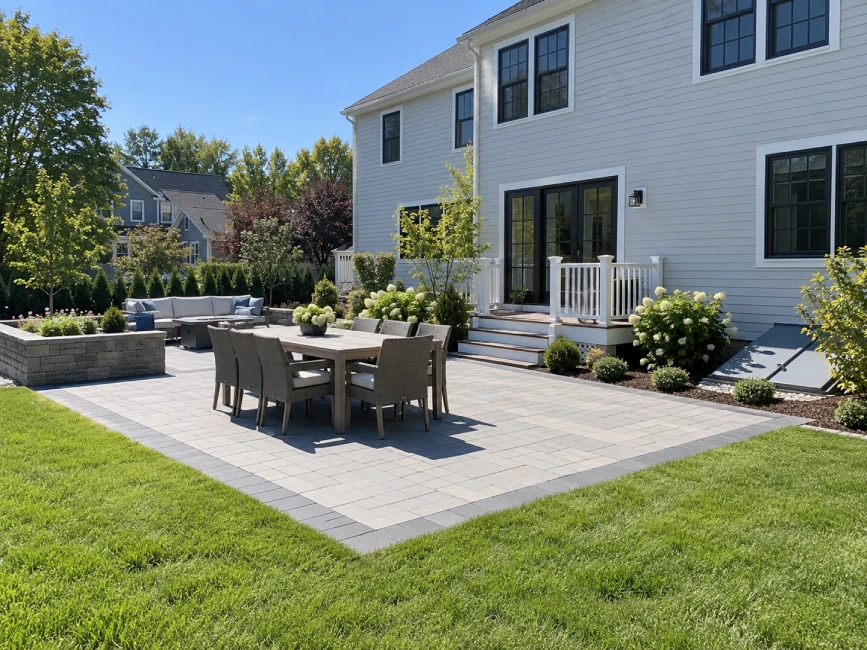
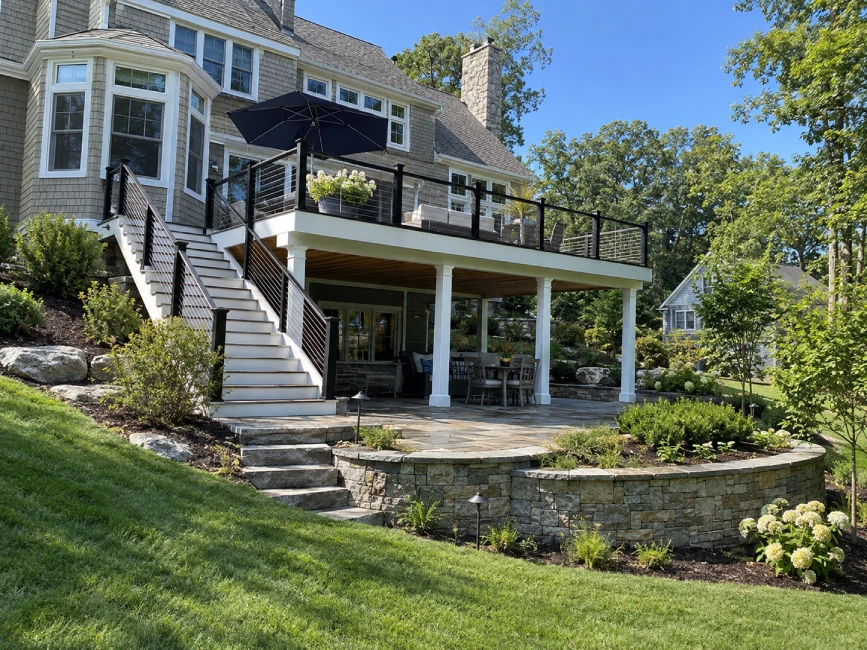
A deck is a raised platform built on posts and footings. It is usually framed in wood and topped with wood or composite boards. A patio sits directly on the ground. It is built from pavers, natural stone, or concrete on a compacted gravel base.
That one difference drives everything else. Because a deck is raised, it can sit level with your back door, even on a hill. A patio, on the other hand, stays close to the ground, so it suits flat yards and blends into the landscape.
Deck vs Patio Cost in Massachusetts
A patio usually costs about half as much as a composite deck of the same size. The gap comes from the structure. A deck needs footings, framing, railings, and stairs, while a patio needs excavation and a well-built base.
Size | Paver patio | Composite deck |
12 × 16 ft (192 sq ft) | $3,500–$8,600 | $8,500–$16,500 |
16 × 20 ft (320 sq ft) | $5,800–$14,000 | $13,500–$26,000 |
20 × 20 ft (400 sq ft) | $7,200–$18,000 | $16,000–$32,000 |
Several extras change the total for both. For a deck, railings, stairs, and built-in benches add up fast. For a patio, seat walls, steps, and drainage are the common add-ons. For a full breakdown, see our guides to paver patio cost in Massachusetts and composite deck cost in Massachusetts.
Custom Deck & Patio Builders Massachusetts - The Pros, Inc.
Book a Project Consultation With Us
Thank You!
Your request has been received. Our team will contact you within 24 hours.
Deck vs Patio: Lifespan and Maintenance in New England
Massachusetts weather is hard on both. Dozens of freeze-thaw cycles each winter test every surface. Even so, each option fails in a different way, and the right build prevents most problems.
Patios last 20 to 30 years when the base is right. In Massachusetts, that means 6 to 8 inches of compacted gravel, laid in thin layers. A thin base is the main reason patios heave or sink. Upkeep is light: clean it once a year, refill the joint sand as needed, and reseal every 3 to 5 years.
Composite decks last 25 to 50 years, depending on the product line. They also need the least work. You simply wash them once or twice a year. Our Trex vs. TimberTech vs. wood comparison covers the brands in detail.
Pressure-treated wood decks cost less upfront. However, they last about 15 years here and need staining or sealing every 2 to 3 years. Skip that step, and the boards crack, splinter, and gray quickly.
Deck vs Patio for a Sloped Yard or a High Back Door
Your yard often makes the deck vs patio decision for you. Start with two questions: how far is your back door above the ground, and how much does the yard slope?
- Back door more than a few steps up: Choose a deck. It puts the outdoor space level with your kitchen, so you avoid carrying food down a long set of stairs.
- Steep slope: Choose a deck. Posts and footings take up the grade, so you don’t have to move tons of soil.
- Gentle slope: A patio still works. A low retaining wall or a few stone steps can level the space, and that often costs less than a deck.
- Flat yard with a low door: Choose a patio. It costs less, lasts long, and connects naturally to the lawn and garden.
Drainage matters too. A patio must slope slightly away from the house, about a quarter inch per foot. A deck lets rain fall through, so standing water is rarely a problem.
Snow, Ice, and Salt: How Each Handles a Massachusetts Winter
Both options survive New England winters when they are built correctly. Still, they behave differently once the snow flies.
A paver patio is easy to shovel. In addition, individual pavers can be lifted and reset if frost ever moves one. A composite deck is best cleared with a plastic shovel, so you don’t scratch the boards. Wood decks hold moisture under snow, which is one more reason they need regular sealing.
Coastal yards in towns such as Marblehead, Swampscott, and Nahant also deal with salt air. Composite boards and natural stone hold up well near the water, while untreated wood weathers faster.
Does a Deck or a Patio Add More Home Value?
Decks recoup more of their cost at resale on paper. In Remodeling magazine’s 2025 Cost vs. Value report, deck additions recouped roughly 79 to 96 percent of their cost. The report’s backyard patio project recouped about 46 to 59 percent. That patio project, though, is a large, high-end build, so a typical paver patio is a smaller investment.
In practice, buyers care about usable outdoor space. A well-built patio or deck that looks finished and fits the house adds appeal either way. A worn-out wood deck, by contrast, can count against a sale.
Fire Pits, Outdoor Kitchens, Hot Tubs and Pools
What you plan to put on the space matters as much as the yard itself.
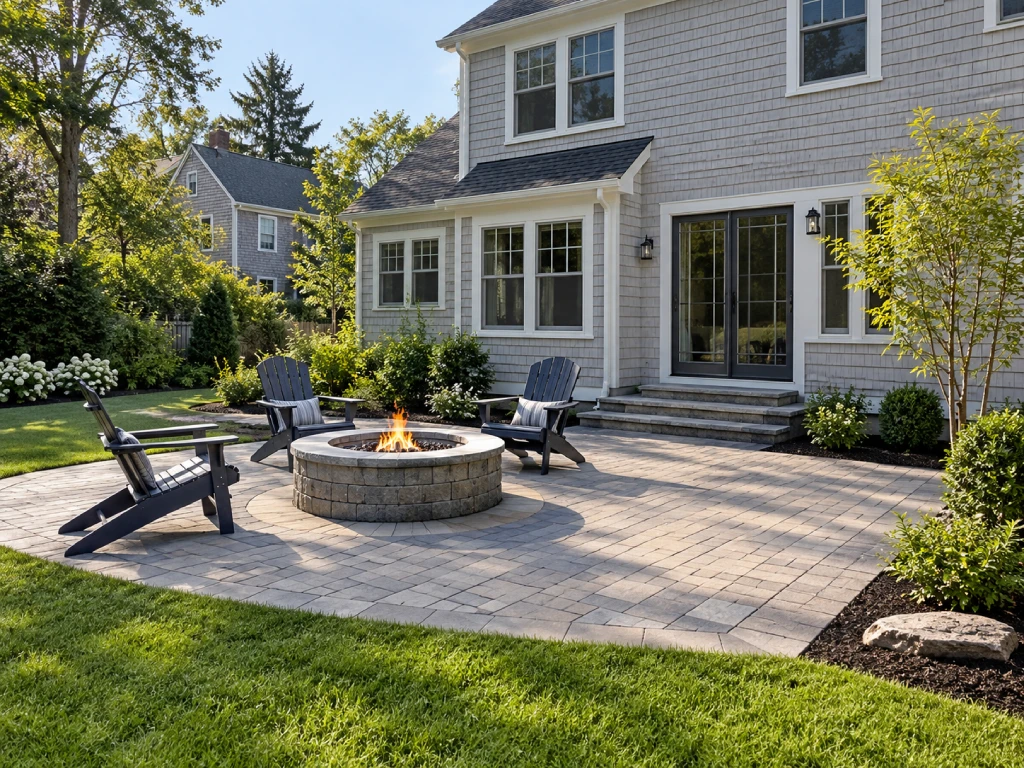
- Fire pits: A patio is the clear winner. Pavers and stone don’t burn, so a wood-burning fire pit belongs on a patio. Some gas fire tables are rated for decks, but a patio gives you more freedom. Browse our backyard fire pit ideas for New England.
- Outdoor kitchens: Stone counters and grills are heavy. A patio carries that weight with no extra framing, while a deck may need added support.
- Hot tubs: A filled hot tub weighs several thousand pounds. A deck must be engineered for that load, whereas a patio or a reinforced pad handles it easily. See our built-in hot tub options.
- Pools: Most pool surrounds are patios, because pavers stay cooler underfoot and resist slipping. Learn more about our pool patios.
When to Choose a Deck and When to Choose a Patio
Choose a deck if:
- Your back door is several steps above the ground.
- The yard slopes steeply away from the house.
- You want a raised view over the yard, the water, or a wooded lot.
- You prefer composite boards with almost no upkeep.
Choose a patio if:
- Your yard is flat or close to it.
- You want the most space for your budget.
- You plan a fire pit, an outdoor kitchen, or a hot tub.
- You want a surface that blends into the garden and lawn.
Why Not Both? The Deck-to-Patio Combo
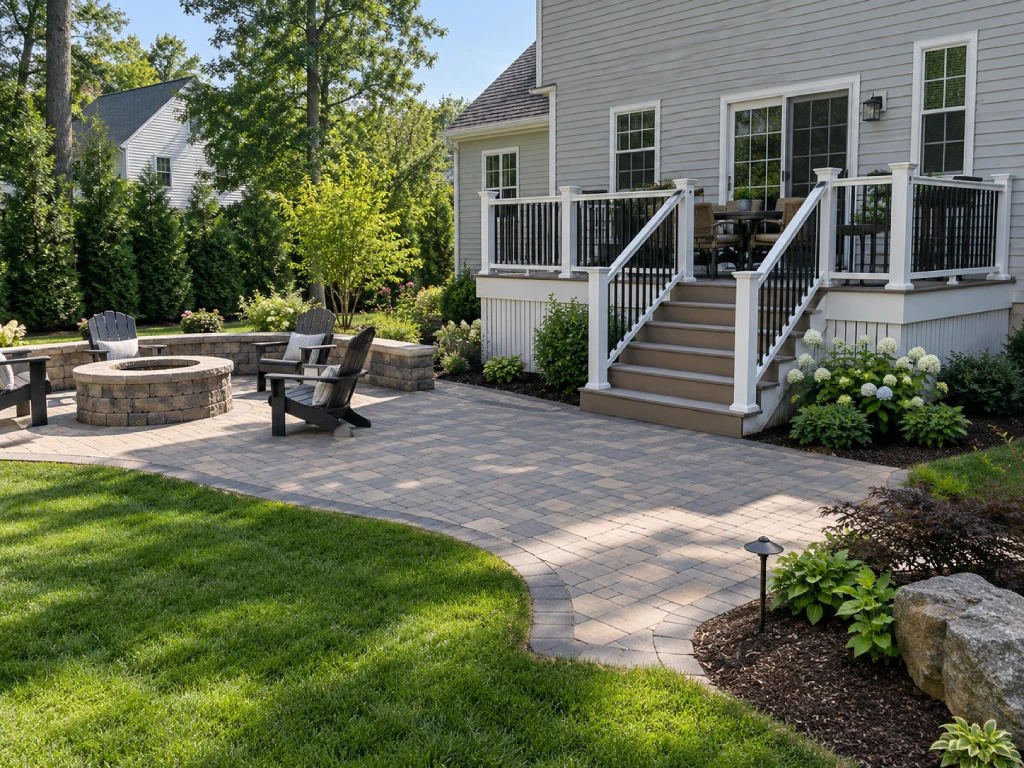
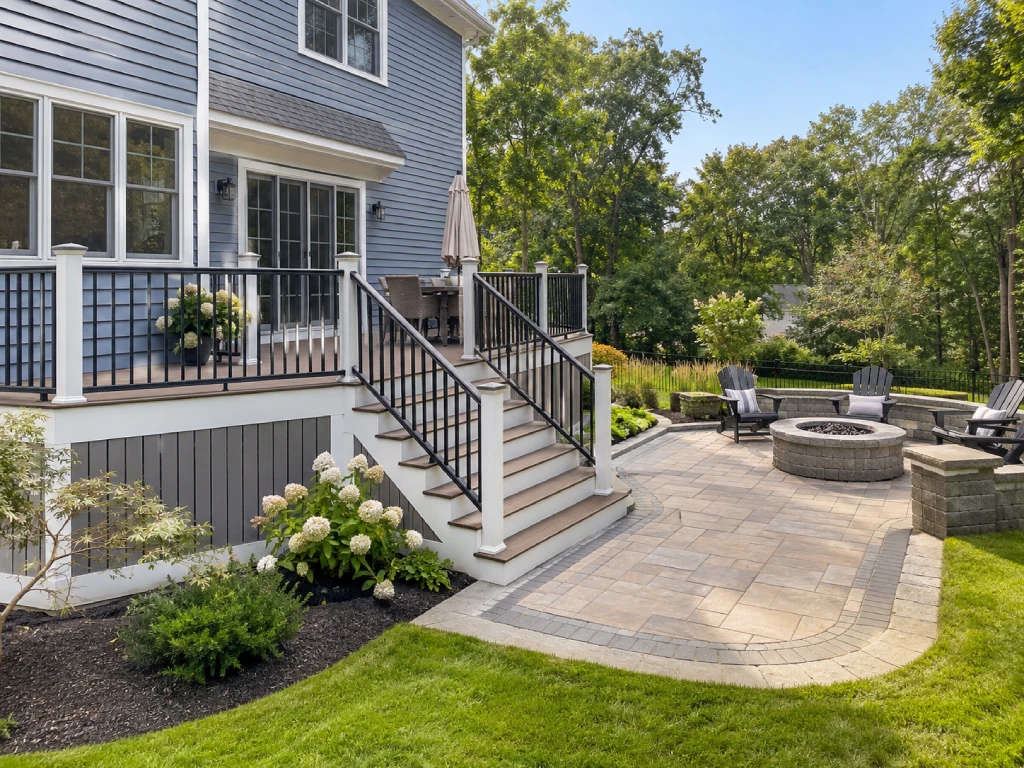
On the North Shore, one of the most popular layouts is a combination. A small deck sits at the back door and then steps down to a larger paver patio. As a result, you get easy access from the kitchen and a lower-cost space below for dining, lounging, or a fire pit.
This layout also lets you build in phases. For example, you can add the deck now and the patio later, as long as the full plan is drawn first. Our outdoor living space design team plans both pieces together, so they fit when the second phase arrives.
Frequently Asked Questions
How much does commercial landscaping in Massachusetts cost? Full-service grounds care usually runs $8,000 to $15,000 per acre each year. That’s $800 to $1,600 per acre monthly. Basic mow-and-blow costs far less. Snow and ice are budgeted apart.
Should snow removal be in the same contract as landscaping? For most sites under about 15 acres, yes. One vendor means one team to answer for the site. The crew that plows in winter also repairs the turf in spring. Larger sites sometimes price better when the scopes are split.
When should I put a landscaping contract out to bid? Send the RFP in late fall or early winter. Award it by February. Crews lock in routes early, so a March award means picking from what’s left.
How often should commercial landscape contracts be re-bid? Every three to five years is standard. Re-bid sooner if quality drops. Set a reminder 90 to 120 days before the end date, so you’re not rolled over automatically.
What should a landscaping scope of work include? Break the site into parts. Turf, beds, trees, irrigation, walkways, wet spots, entries. Set a clear standard for each. Here, also add salt damage repair, plow-edge repair, and grit removal.
Why do commercial landscaping bids vary so much? Usually the scopes differ, not the prices. A low bid often leaves out beds, flowers, or irrigation. Ask every bidder to list what’s excluded, so the gaps show.
How The Pros, Inc. Helps You Choose
Still unsure? That’s normal, because the right answer depends on your yard. The Pros, Inc. builds both patio decks and patios and walkways across the North Shore, Essex County, and Middlesex County.
First, we visit your property and check the slope, the door height, and the drainage. Then we show you both options in 3D, side by side, in your own yard. That way, you can see the difference before you spend a dollar on construction.
Ready to settle the deck vs patio question for your yard? Request a free design estimate or call (857) 574-4380. Our office at 29 Hanover St in Lynn is open Monday to Friday, 9 AM to 6 PM, and Saturday, 9 AM to 4 PM.
Deck and Patio Building Contractor MA