The best sloped backyard ideas turn one steep hill into a few flat, usable levels. Terrace the slope with retaining walls, add a level patio or deck, connect the levels with wide stone steps, and cover the steepest parts with deep-rooted plants instead of lawn. Plan drainage first, because water causes most slope problems in Massachusetts.
Key takeaways
- Measure the slope first. The steepness decides which ideas work, from simple regrading to engineered terraces.
- Terraces create flat space. Two or three low walls usually look better and hold up better than one tall wall.
- Drainage comes before design. Grade water away from your house and give runoff a path to follow.
- Lawn is hard on a hill. Groundcovers and native grasses hold soil better and skip the risky mowing.
- Taller walls need permits. In most Massachusetts towns, retaining walls over 4 feet need a building permit and often an engineer.
Why Sloped Backyards Are So Common in Massachusetts
Many North Shore and Middlesex County homes sit on hills, ledge, and glacial soil. As a result, the backyard often drops away from the house or climbs toward the property line. That leaves homeowners with the same frustrations: a lawn that’s hard to mow, soil and mulch that wash away in storms, water that runs toward the foundation, and no flat spot for a table, a fire pit, or kids to play.
The good news is that a sloped backyard is also an opportunity. Levels add depth and interest that a flat yard can’t match. With the right sloped backyard ideas, a hill becomes a set of outdoor rooms, each with its own purpose.
First, Measure Your Sloped Backyard
Before you choose between sloped backyard ideas, find out how steep your slope really is. You need a tape measure, two stakes, string, and a line level.
- Set one stake at the top of the slope and one at the bottom.
- Tie the string to the top stake at ground level, then run it to the bottom stake.
- Level the string with the line level.
- Measure the rise: the height of the string above the ground at the bottom stake.
- Measure the run: the length of the string between the stakes.
- Divide the rise by the run and multiply by 100 to get the slope as a percentage.
For example, a 3-foot rise over 30 feet is a 10% slope.
Slope | What it feels like | Ideas that usually fit |
Gentle (under 10%) | Easy to walk and mow | Regrading, a level patio, garden beds, a winding path |
Moderate (10–25%) | Noticeable climb; mowing gets awkward | Low retaining walls, two or three terraces, steps with landings |
Steep (over 25%) | Hard to stand on; soil washes away | Engineered terraces, a deck, groundcovers, professional design |
These ranges are a practical guide, not a rule. Soil, drainage, and what’s below the slope matter as much as the number.
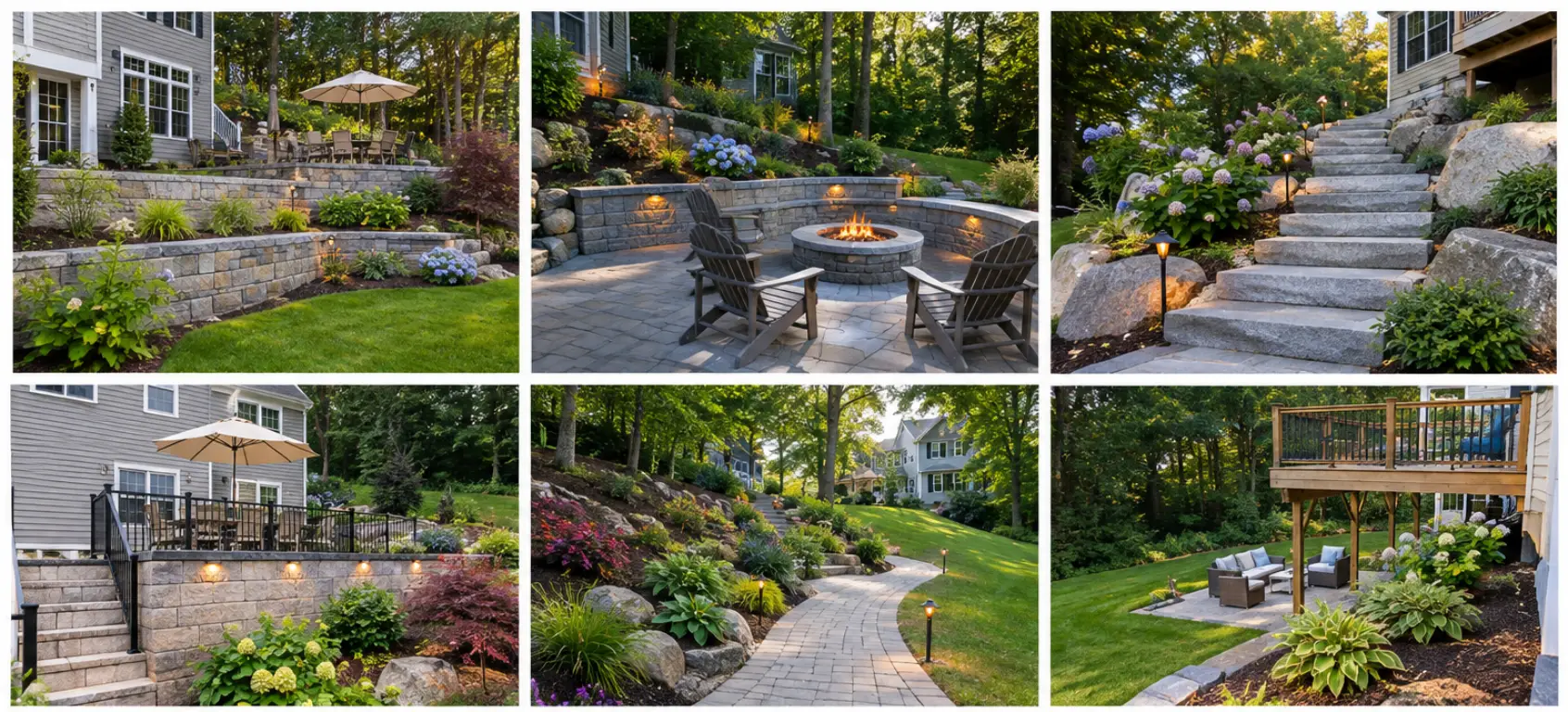
12 Sloped Backyard Ideas That Create Usable Space
1. Terrace Your Sloped Backyard Into Levels
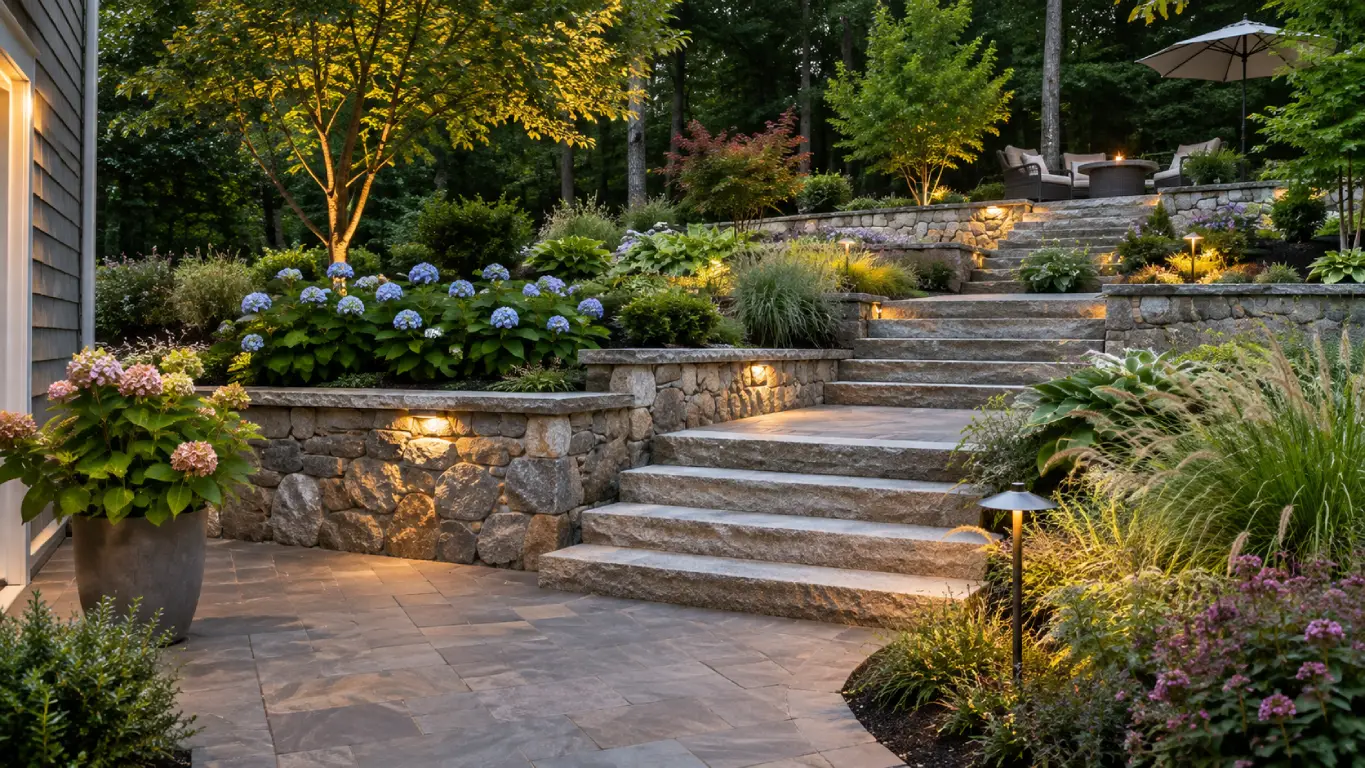
A terraced backyard is the classic answer to a hill, and one of the most popular sloped backyard ideas. Instead of one long slope, you get two or three flat levels held by low retaining walls. Each level can do a different job: a dining patio near the house, a lawn or garden in the middle, and a fire pit or planting bed at the bottom.
Terracing a slope also spreads the soil pressure across several short walls, rather than one tall wall. That’s why tiered walls are often safer and easier to permit. See our 12 retaining wall ideas for wall styles that suit terraces.
2. Build a Retaining Wall for a Sloped Backyard Patio
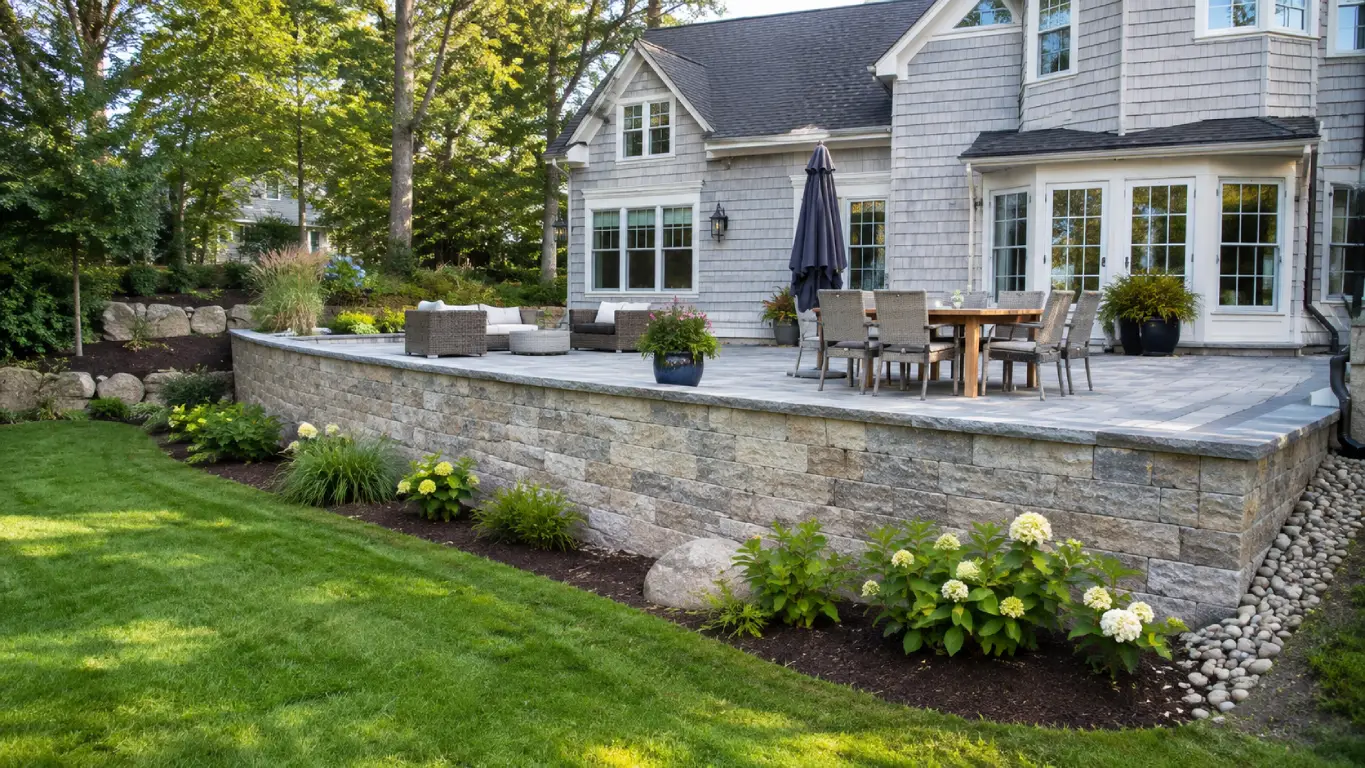
If you need just one big flat area, a single retaining wall for a sloped backyard can do it. The wall holds back the hill, and the space in front becomes a level patio or lawn. In a downhill yard, the wall can also hold up a raised patio that looks out over the yard.
Every retaining wall on a slope needs gravel backfill and a drain pipe behind it, because trapped water is what pushes walls over. Our retaining wall service covers block, natural stone, and boulder walls.
3. Add a Sunken or Raised Patio
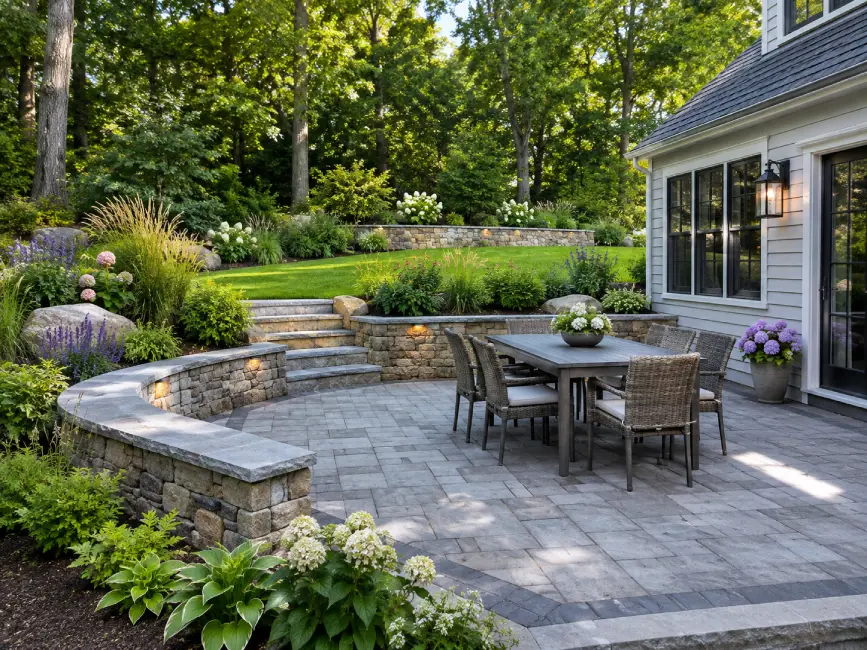
A sunken patio is cut into the uphill side, with low seat walls around it. It feels cozy and sheltered, and the walls double as extra seating. A raised patio works on the downhill side, where it creates a level platform with a view.
Either way, the patio needs a compacted crushed-stone base and a slight slope for drainage. See our patios and walkways service for materials.
4. Connect the Levels With Stone Steps
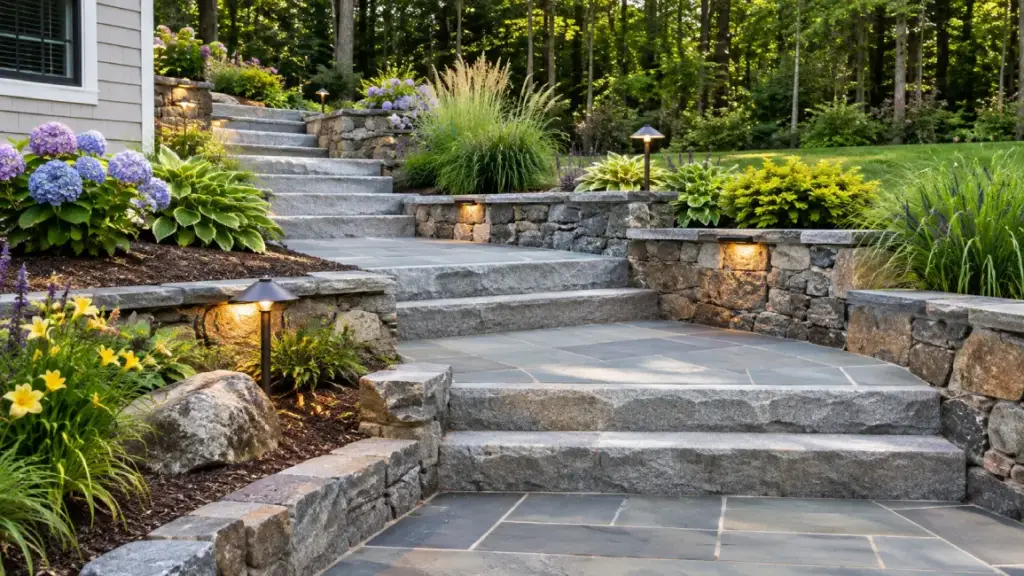
Steps turn a sloped backyard you avoid into a yard you use. Wide, shallow outdoor steps feel safer and more inviting than steep ones. A common design guide is that twice the riser height plus the tread depth should equal about 26 to 27 inches. For example, a 6-inch riser pairs well with a 14- to 15-inch tread.
Granite, bluestone, and natural stone slabs suit New England homes and handle frost well. On long climbs, add a landing every few steps so the walk feels easy.
5. Wind a Path Across the Hill
On a gentle or moderate slope, a path that zigzags across the hill is easier to walk than one that runs straight down. Each switchback can lead to a bench, a garden bed, or a view. Use pavers, stone, or compacted gravel, and edge the path so it doesn’t wash out.
6. Build a Deck Over the Slope
A deck is often the simplest way to create flat space on a steep drop, especially off a walkout basement or a raised first floor. Footings must go below the frost line to stop the deck from heaving. The space under a high deck can become storage or a shaded patio. Not sure which fits your yard? Read our guide to deck vs patio for a Massachusetts backyard.
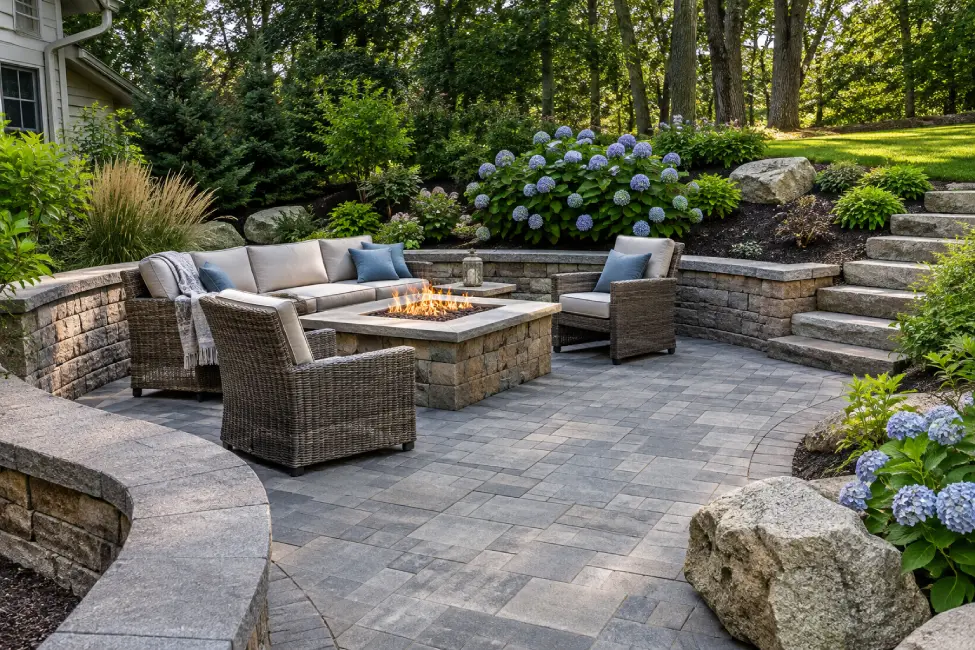
7. Create a Fire Pit Terrace
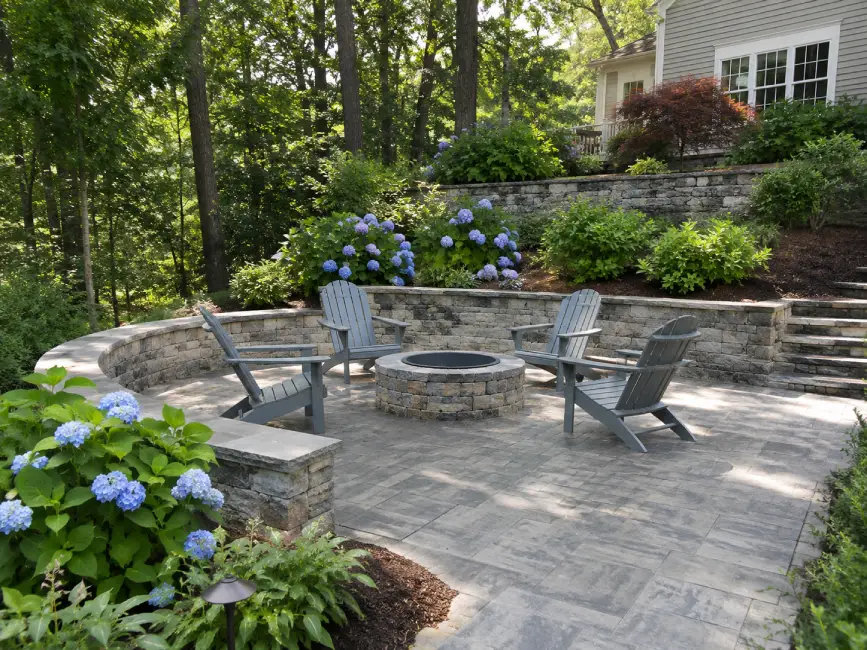
The bottom or middle of a slope is a natural place for a fire pit. Cut a level circle into the hill, build a curved seat wall on the uphill side, and you get a built-in amphitheater. It’s one of the most popular hillside backyard ideas because it uses the slope instead of fighting it. Browse our backyard fire pit ideas for designs.
8. Turn the Hill Into a Rock Garden
Boulders and native stone look at home on a New England slope. Set large rocks partly into the soil, as if they’ve always been there, then plant hardy perennials and low shrubs between them. The rocks slow runoff and hold soil, and the result needs far less care than lawn.
9. Use Groundcovers for Erosion Control on a Slope
Steep banks in a sloped backyard are hard and risky to mow. Groundcovers and native grasses are a better fit, because their roots knit the soil together and help with erosion control on a slope. Good choices include Pennsylvania sedge for shade, little bluestem for sun, creeping phlox for color, and common juniper for rocky, dry slopes, according to Penn State Extension.
Plant in spring or fall, mulch at least 2 inches deep, and use biodegradable netting on steep spots until the plants fill in. Our plants and garden design team can choose plants for your sun and soil.
10. Add a Dry Creek Bed for Drainage
A dry creek bed is a shallow channel lined with river stone that carries storm water down the slope. Most of the year, it looks like a natural stream bed. During heavy rain, it moves water safely away from your house and patios. It’s an attractive way to solve sloped backyard drainage problems.
11. Build Tiered Garden Beds
Small terraces make great raised beds for vegetables, herbs, or flowers. The walls warm up in the sun, the soil drains well, and you don’t have to bend as far. Stone, block, or timber edges all work for low beds. Our guide to raised garden beds in Massachusetts covers soil and sizing.
12. Light Every Level
Lighting makes sloped backyard ideas safer and more beautiful at night. Light every step and landing, wash light across the face of retaining walls, and add a few path lights along winding walkways. Our landscape lighting service designs low-voltage systems for multi-level yards.
Hardscaping Company Massachusetts - The Pros, Inc.
Book a Project Consultation With Us
Thank You!
Your request has been received. Our team will contact you within 24 hours.
Plan Sloped Backyard Drainage First
Water is the main reason sloped backyard projects fail. Rain runs downhill, picks up speed, and carries soil with it. If the slope falls toward your house, that water can end up against the foundation.
Building codes based on the International Residential Code, which Massachusetts’ residential code follows, generally call for the ground to fall at least 6 inches within the first 10 feet away from a house. In addition, a good slope plan usually includes:
- Regrading so water moves away from the house and patios
- Swales, which are shallow, grassed channels that guide water around the yard
- French drains behind walls and along the base of the slope
- Dry wells or a dry creek bed to collect and slow heavy runoff
- Gravel backfill and drain pipe behind every retaining wall
Sloped Backyard Rules in Massachusetts
- Retaining wall permits. In most Massachusetts towns, walls over 4 feet tall need a building permit, and taller or structural walls often need an engineer’s design. Some towns set a lower limit, so check with your local building department.
- Wetlands. Under the Massachusetts Wetlands Protection Act, work within 100 feet of a wetland usually needs review by your town’s Conservation Commission.
- Dig Safe. State law requires a call to Dig Safe before any digging, so buried utilities get marked.
- Neighbors and property lines. Changing a slope can send water onto a neighbor’s yard. Plan drainage so runoff stays on your property or goes where it safely can.
What Does a Sloped Backyard Project Cost?
The cost of sloped backyard ideas depends on how steep the slope is, how many walls and levels you need, materials, drainage, and site access. Walls and drainage usually take the biggest share of the budget. For typical Massachusetts price ranges, see our guides to retaining wall cost, paver patio cost, and backyard renovation cost.
Frequently Asked Questions
What can I do with a sloped backyard?
Terrace it into flat levels with retaining walls, then add a patio, deck, fire pit, or garden beds on each level. Connect the levels with stone steps, and plant groundcovers on the steepest parts.
What is the cheapest way to landscape a sloped backyard?
Planting groundcovers and native grasses is usually the least expensive option. Low timber or block walls and a gravel path are also budget-friendly ways to add usable space.
How do I stop erosion on a slope?
Cover bare soil with deep-rooted groundcovers or native grasses, mulch at least 2 inches deep, and use biodegradable netting until plants fill in. Then slow runoff with terraces, swales, or a dry creek bed.
Do I need a permit for a retaining wall on a slope in Massachusetts?
In most Massachusetts towns, walls over 4 feet tall need a building permit, and taller walls often need an engineer. Some towns set a lower limit, so check locally.
Is it better to terrace or use one retaining wall?
For most slopes, two or three low terraces are better. They spread soil pressure across several walls, look more natural, and are often easier to permit than one tall wall.
How do I fix drainage on a sloped backyard?
Grade the soil away from your house, add swales or a dry creek bed to guide water, and install French drains or dry wells where water collects.
Can you put a patio on a sloped backyard?
Yes. Cut a level area into the hill with a retaining wall for a sunken patio, or build up the downhill side for a raised patio. Both need a compacted base and drainage.
When is the best time to start a sloped backyard project?
Plan in fall or winter, then build from spring through late fall. Early planning gets your design and permits ready before the spring rush.
How We Turn a Sloped Backyard Into Usable Space
At The Pros, Inc., every sloped backyard starts with a site visit and a plan, not a guess.
- Site visit. We walk the slope with you, look at drainage, soil, and access, and talk about how you want to use the space.
- Design in 3D. We show your terraces, walls, steps, and patio in 3D landscape rendering, so you can see each level before anything is built.
- Drainage and permits. We plan grading and drainage first, then handle Dig Safe and help with any town approvals.
- Build. Our own crew excavates, builds frost-ready bases and walls, installs drainage, and finishes the hardscape and planting.
We design and build sloped backyards across the North Shore, Essex County, and Middlesex County. See our hardscape design services and landscape design services.
Ready to use your whole yard? Request a free consultation or call (857) 574-4380. We’re open Monday to Friday, 9 AM to 6 PM, and Saturday, 9 AM to 4 PM.
The Pros, Inc. Hardscaping Company MA